Archive for the ‘Hand tools’ Category

Drill Baby Drill

Tuesday, February 14th, 2012

This morning’s surfing, along with some memory tingling, produced some time travel I found interesting.

To start it off, “baconj,” The keeper of the Plane Shavings blog wrote “Purty Tools just Plain Work Better.” He writes about refurbishing a Millers Falls #2 eggbeater drill. Millers Falls started making these drills in 1886 and continued well into the 1940s. So, “baconj”‘s drill was likely operating 100 years ago, was operating last month, and is running even better now that he made it pretty again. He did a very nice job.

Along that same line, my own Goodell-Pratt #259, not yet 100 years old, saw lots of service before it came to me, and gets used a few minutes per week these days.

The very next blog entry I read was by Joel Moskowitz lamenting “When Good Tools Go Bad and Other News.” Joel, who now operates the very fine Tools For Working Wood in Brooklyn recalls his time working for Black and Decker when they were building “consumer” grade power tools. The justification for stepping down from higher grade professional tools to consumer grade was that the average homeowner used their drill less than 2 minutes a year. Joel goes on to describe quite a few common problems these tools have and how to fix them. It is a good read if you have a hand tool with one of those problems. It’ll save you some money. At the same time, Joel does put in a suggestion about buying a truly professional quality Festool instead.

photo of old electric drillThat comment about 2 minutes a year fired off a bunch of neurons in my feeble old mind, and I ran downstairs to take a picture of my old reliable power drill. It has definitely see more than 2 minutes a year, probably a lot closer to 2 hours a year averaged over the time I’ve had it. Some years, like the time we built a deck, it saw many many hours.  I bought this 1/4 inch electric drill in 1964 or 1965 when I took up a part time job hanging draperies that Anita made. (a seamstress I worked for, not a relative, last name long forgotten) I bought the drill at a discount store in Indiana named T-Way for the grand sum of $9.95. It is branded Shop-Craft and was manufactured by Portable Electric Tools Inc. in Geneva, Illinois. Those folks went out of business in the late 60s, or actually, were bought by another firm, and then bought again by Shopsmith, and eventually discontinued. I’m guessing the Black and Decker descent to consumer grade killed their market. For me, it was one of the best 10 dollars I ever spent.

As an aside, I’ve never had a problem of any sort with that Shop-Craft drill. I did fall to the siren songs of those cordless things and went through 3 generations of them. I found them mostly wimpy and while none of them actually failed mechanically, all 3 fell victim to design obsolescence of their batteries. By the time the batteries would no longer take a charge, replacements cost 3 times as much as the next great (consumer grade) cordless drill. What a great way to stuff the land fill!

Which is the reason I won’t buy a Festool drill. First, my pockets aren’t deep enough to pay 23 times as much as I did for the old reliable drill which I still use today. Secondly, I’m very skeptical about the rapidly changing battery technology. The drill itself might not fail in a reasonable lifetime, but how long will replacement batteries be available? If you’re a pro and really do use these things an hour or more a day, or if you just want to have the same things that Mark and Tommy have, go ahead.

You can’t have my $9.95 drill. I still use it. Yet, you can find really great Millers Falls and Goodell-Pratts on the used market. Augment those with a Stanley brace for the heavier work, and Drill Baby Drill.


Hollows and Rounds after the bath

Monday, January 30th, 2012

Tobias asked about any ill effects of using vinegar. So, here are a couple of pics of the results of an overnight bath in plain old, edible, distilled white vinegar. (straight from the grocery store, 5% acidity) Metal that was not previously rusted shows no noticeable change. Places where there was red rust are now free of the roughness, but are darker gray. There were some blotchy darker areas that are unchanged.  Heck, I’m only 1/3 the age of these plane irons and I’ve got blotches.

photo of derusted plane irons close up photo of de-rusted irons

Next: sharpening, which as I mentioned to “Boy” will be freehand using  a course India stone and two finer grades of Arkansas stones. The rounds can be sharpened on normal flat stones, the hollows on rounded edge slip stones.

Hollows and Rounds

Monday, January 30th, 2012

photo of plane blades soaking in white vinegar“The larger project” that I made shelf brackets for involves the collection of hollows and rounds molding planes I acquired last fall. This project wants at least a couple of them to be tuned up for peak performance. Now that our winter weather has brought dry air, the planes are much easier to disassemble and adjust. A couple of hammer taps on the trailing end knocks the blades loose easily. In the muggy fall, they needed a lot more beating to get the parts to move. So…. since it’s so easy, let’s clean all of them.

One thing is very obvious. The previous owner had a lot more love for the rounds than the hollows.

A few hours in my favorite non-toxic rust remover, white vinegar, will clean them up nicely. The wooden bodies and wedges are so clean that wiping down with mineral spirits is all they need.

P.S. For anyone considering using vinegar for rust removal, keep it away from your workbench. Vinegar does a good job of “ebonizing” the fir my bench is made of.

More Gouge and Chisel Racks

Monday, December 19th, 2011

Then there were three. The second is the same as the first, fit for a variety of carving tools. Yes, I like those Ashley Iles tools.

For smaller carving, I  have a few small gouges, a few Pfeil palm gouges, and a few Dockyard micro tools. A rack for those tools is a little different. It’s scaled down because the tools are smaller. The angled bard is also smaller, made from a 1×3, leaving more room for the tools in front. The palm tools hang better in holes than sitting up resting on their handles, so the lower shelf has full holes instead of notches. Over at the right end, the micro tools need a little extra help standing up. Note the little wedge that forms a shelf on the angled board.

(click photos for larger views)

photo of 3 racks hanging on the wall photo of rack for smaller tools

Gouge and Chisel Racks

Wednesday, December 14th, 2011

The tool rack behind my bench was infested earlier this year by a deluge of carving chisels and gouges. As they arrived, all the rest of the tools scrunched together and made room. Nice, friendly tools. photo of gouge rack hanging on the wallNo, there are no wall cabinets, tool chests, or stacks of drawers in my shop. Tools kept in open racks are a lot easier to find and are quicker to come to hand. There were good intentions to build special racks for the new gouges and chisels, but other things (like learning to use them) came first.

While collecting about a bizillion pictures of chisel racks, one particular design caught my eye. This kind of rack will be at home sitting on the bench, or hanging from a French cleat on the end wall of the shop. The person who posted the pictures did not mention dimensions, but they were not hard to determine. A few sketches were useful for coming up with dimensions that ensure the tools don’t slide out and crash onto the concrete floor. The key to these racks is a “floor” piece that sits at a 45 degree angle.  The rest is so simple that real plans aren’t needed. Most parts are made from either 1×3 or 1×4 standard lumber … and from a few 1x? pieces from the cutoffs pile.

photo of sawing with a bench hookOK. Let’s get started. Measuring things with rulers and other such devices can introduce all sorts of errors. (How many times have you misread a ruler?) So, I tend to use as few actual measurements as possible. This rack has only a few specific measures. The end pieces stand 8 inches tall. The long pieces are all 17 and 1/2 inches long. The bottom of the lower shelf is 3 and 1/2 inches above the bench. The holes in the shelves are on 1 and 1/2 inch centers, starting with the first 1 and 1/4 inch from one end. Everything else is measured directly from the components … and a randomly selected jar cap.

Only two pieces are actually measured for cutting, one 8 inch end piece and one 17.5 inch long piece. All the rest are cut using theses pieces as the measure. Since I use a pull saw for almost everything (I’m not a cabinet maker), my bench hook is hooked from the back side of the bench.

photo collage of making the baseThe tilted base sits at a 45 degree angle. It is made from a 1×4. The French cleat also needs a 45 degree angle.It is made from a 1×3. So, several edges need to be cut to 45 degrees. Use the bandsaw? No, it’s messy getting it setup to cut right at the very edge. Besides, using hand planes justify needing power from Milky Way bars. The work is actually very quick with a cambered blade in the jack plane doing most of the work. Get out that ole plastic triangle that’s left over from a freshman engineering course (50 years ago). Mark, rough plane, and follow up with one or two passes from a smoothing plane. Like my shooting stick? I’ll make a real one someday.

Click on the images to expand them.

photo collage of making the hole stripsThe rack has two shelves with holes in them. Make one stick. Drill a series of holes in it. Cut it in half (almost.) The layout line is actually 1 inch from one edge of a standard 1×3. The holes are 1 inch in diameter, made with an old Stanley bit brace and an auger from an ancient set of Russell Jennings bits. The extension lips needed a bit of gentle honing to remove what looks like a collision with a screw or nail. (Previously owned bits!)

A secret to success with these fine double threaded augers is to drill only partially through the lumber. Then, flip the piece and drill the remainder from the other side. This prevents the “blow out” that happens if one simply drills straight through. I prefer to use the leg vice to hold the workpiece. Two reasons. One is so I can reach underneath to feel the tip of the bit breaking through. The other is to prevent splitting. (Experience!)

photo collage for cutting a dadoTurning to the end pieces, there is a through dado for that 45 degree floor piece, and a couple of short stopped dadoes for the shelves. Layout used that 45 degree drafting triangle for one mark. Then, the actual lumber pieces were used for the remaining dado outlines. I set my shopmade router plane to the final depth I wanted (about 1/4″), and used it to mark the edges for depth. Thanks St. Roy for that tip! Pencil layout for the 45 degree dado was followed by substantial knife layout (using one of Bob Zajicek’s superb Czeck Edge knives), and then by chiseling a fine wedge on the waste sides of the lines. This produced a groove for the saw to track. Even a whippy pull saw can track a groove like that. Saw to depth. Use a bench chisel to zip out most of the waste. Complete with the router.

The short dadoes were simply chopped and pared. All of this work was at a comfortable height using the BOB.

photo collage for completing the end piecesA nicely rounded corner completes the end pieces. Measure? Use a compass? Naw, grab something round. Then use one of my favorite tools, a shopmade turning saw, along with a gigantic bird’s beak sawing fixture. Wow, that saw is a pleasure to use! Unfortunately, I need to follow up with my least favorite tool: sandpaper.

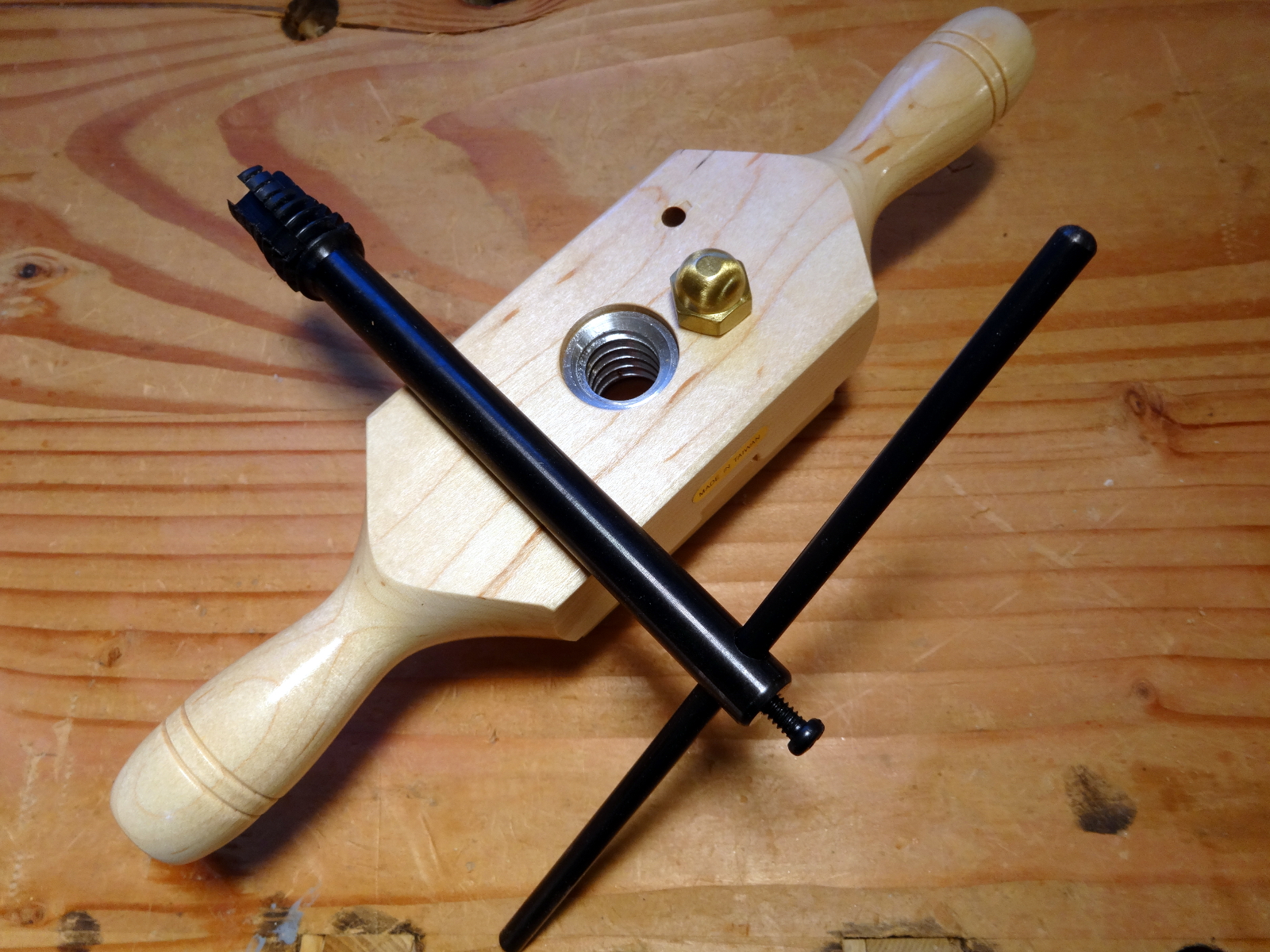
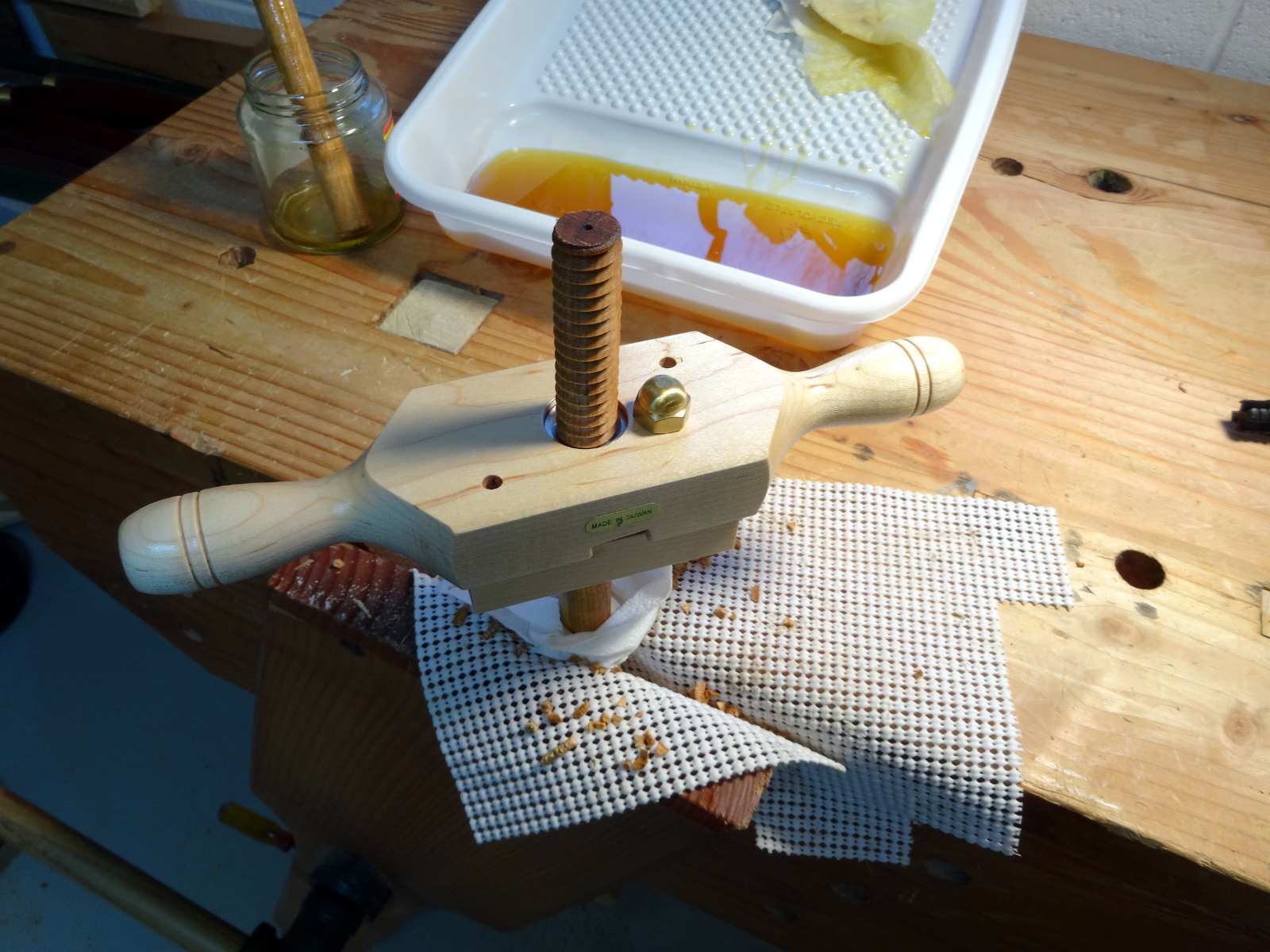
The racks that inspired this build have no visible screws or nails. Maybe the builder used only glue? With each rack capable of suspending several hundred dollars worth of sharp objects above a concrete floor, I want a little more than glue. Out comes the Goodell-Pratt eggbeater and the Fuller countersink bits.

photo collage of final assemply and finished rackA couple of clamps hold pieces together accurately while screws are used only enough to mark where pilot holes need to be drilled. More beating with the eggbeater, and it all goes together neatly. Now that the basic rack is built, a piece of cleat is measured against the rack, cut to fit, drilled and attached. The same routine goes for a strip at the bottom, which keeps the rack vertical against the wall.

Perfect. It fits nicely right next to my shop desk, which also rides on a French cleat.

The title of this posts uses “racks,” plural. Yes, there are more to come, and more French cleat runs on that wall.

… and for the guy who asks “Shouldn’t chisels be stored with the sharp ends down?” I’m going to find where you live and seal up your garage door with your car inside … just so you don’t hurt anyone with it.

Sharpening Woodcarving V-Tools

Friday, April 22nd, 2011

My first foray into carving was way back in early grade school. Dad taught me to carve a simple Scotty dog from a bar of Ivory soap with a pen knife. No V-tool was needed for that work.

By the way, this is a simple beginner carving project. The parts of the dog are blocky, the soap easy to carve, and even a simple blocky carving gives a sense of accomplishment. Be careful of breaking off the tail.

Somewhere in the middle of Boy Scout years, carving a wooden chain was intriguing for a while (“a while” means 5 or 6 inches of chain). No V-tool was needed for that work.

More recently, carving the scrolls on the stems for the Fiddlehead canoe brought carving back to the forefront. No V-tool was needed for that work either.

photo of botched up v-toolThe small set of inexpensive Ramelson “Beginner” carving tools purchased for the Fiddlehead work included a V-tool, but it wasn’t needed for the project. Besides, it was cast lopsided with one side wall thicker than the other. Not long after taking up the most recent interest in carving, I decided to fix that V-tool. The first photo shows the result. With it unsuccessfully ”fixed” … through many grindings, it is now reground to be a very short gouge with something like a #5 radius.

photo of several good v-toolsThere’s a BETTER solution! Learn to sharpen a V-tool correctly. Chris Pye, a traditional woodcarver once published a collection of eBooks he called “Slipstones.” One of those was a 102 page book titled “Select and Sharpen Your V-Tool.” Holy pages Batman! 102 pages???! Yes, it’s a very comprehensive tome, spending a lot of time describing v-tools and offering advice on how to select the one(s) you might want.

The part of the book about sharpening clarifies the “secret.” In short, it advises one to think of a V-tool simply as two chisels joined at the keel. Sharpen each chisel independently, but to the same angle, and “voila!” you have a sharp V-tool. If that brief explanation isn’t enough, there are about 50 pages in the eBook to explain the details.

Chris recently upgraded his web site, and in the process the eBooks slid into that deep dark spot full of lost stuff from reworked web sites. Chris has also started a new “Woodcarving Workshops” web site offering excellent video instruction for a very wide range of woodcarving topics. There he offers professional instruction (for a reasonable fee) as series of very concise and expertly produced videos. Take a look.

I asked Chris about the missing eBooks. He answered that he’ll bring them back eventually, but for now suggested that I forward on to those who might want them any that I have. So, for a limited time, get your copy of Chris Pye’s ”Select and Sharpen Your V-Tool” ebook.