After taming the Hamsticks, I turned my attention to effectiveness. How do these antennas compare to another in my collection?
Contestant 1: Hamstick verticals
I have used various forms of 1/4 wave ground mounted verticals, including the Hamsticks, for quite a while. They have the attributes of being relatively low cost, easy to setup almost anywhere, and will perform. Yes, everyone calls them “compromised,” but that’s a term that can be applied to most any antenna. I use my verticals as “backyard portable” from my home QTH in the midst of an HOA community. I have no objections from wonderful neighbors, and no complaints from passers-by who probably can’t even spot the antennas.
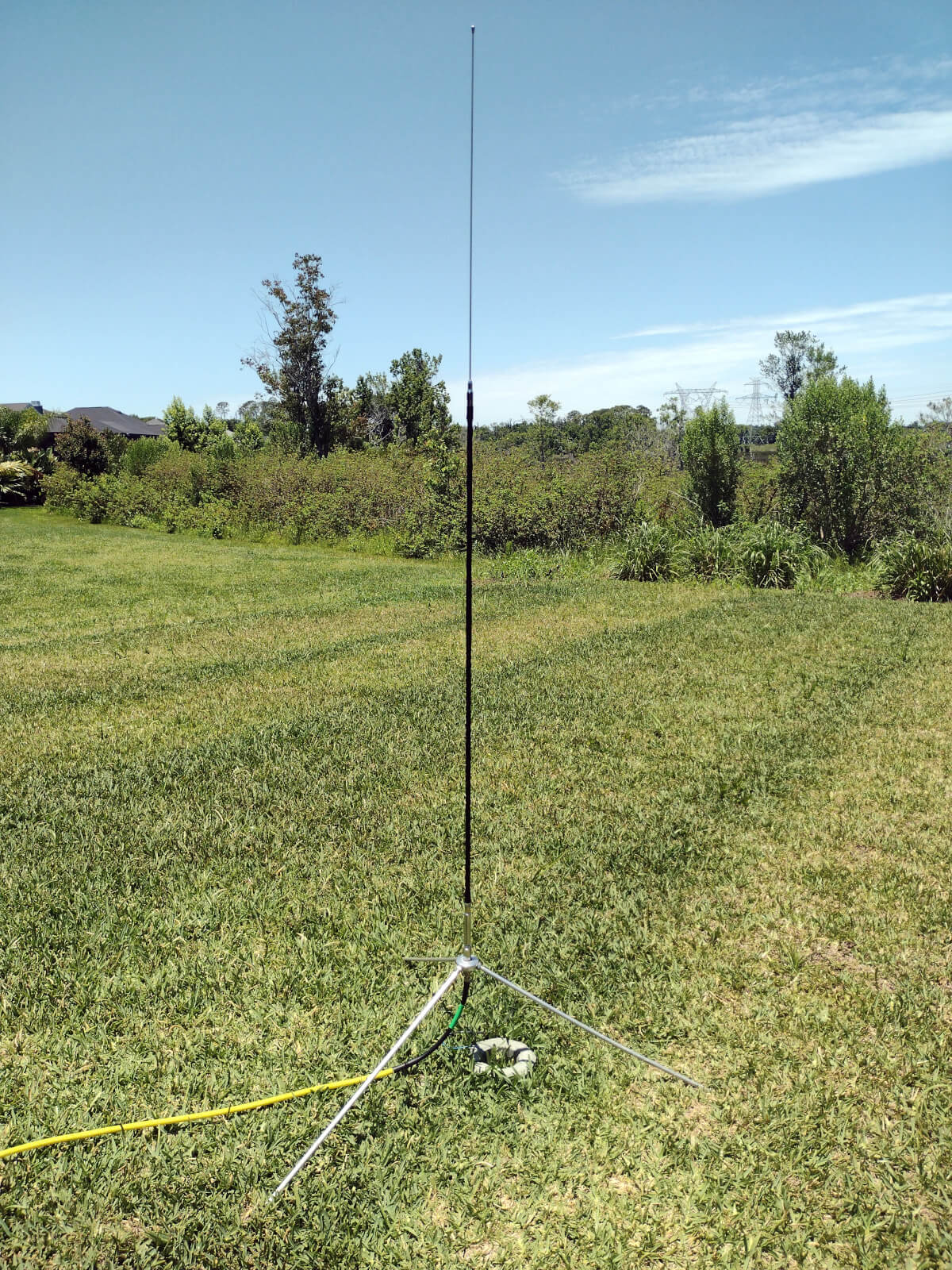

There’s a radial field under the antenna, 16 radials of 18 feet each.
For some Hamstick variations, I use loosely deployed radials above ground. See the taming article for more details.
For almost all verticals, dragonflies are attracted to the tops. Dunno why.
Contestant 2: DX Engineering TransWorld 2010
I also use a DX Engineering TW2010 from time to time for the 20M through 10M bands. The TW2010 is a 5 band vertical dipole. Each side of the dipole is a “T” shaped section. A box between those sections contains a group of loading coils. It is about 5 feet wide and stands 8 and 1/4 feet tall. DX Engineering originally acquired the design from someone else and then set about its own manufacturing. I can confirm that it is well built, of fine quality materials, and engineered for easy set-up.
The only complaint about the physical form is that the 4 legged base occasionally spontaneously self-disassembles. (Thanks Elon for that description.)
DX Engineering describes the antenna as “portable” because they offer a carry bag about the size of the typical golf bag. Now, add to the antenna parts the 65 feet of coax that’s used for impedance matching, and the “portable” antenna becomes, in my mind, not man portable, but truck portable. … about 30 pounds.
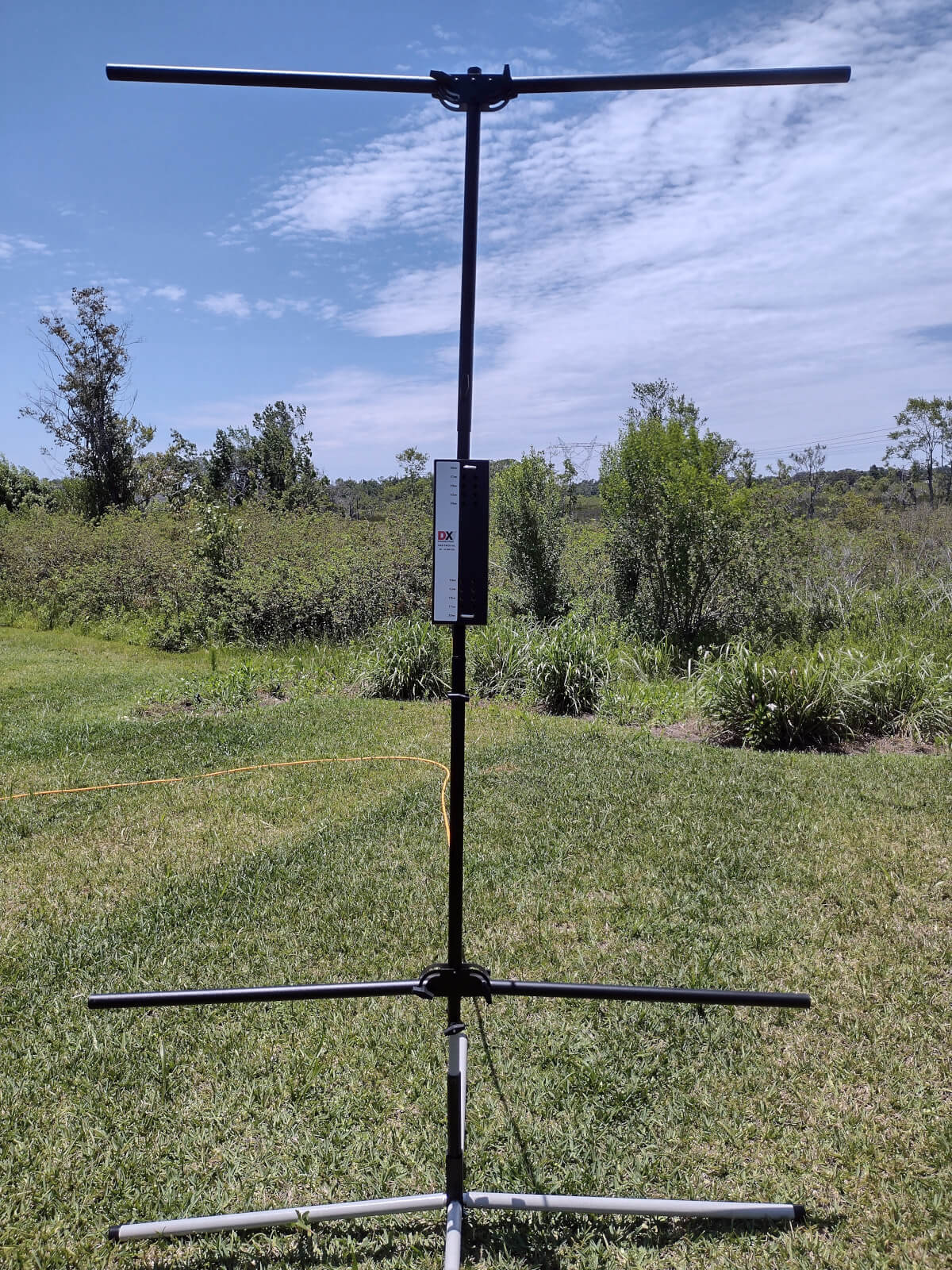
P.S. KA3DRR, Scott Morrison, drags his TW2010 around in a wagon he calls Land Rover One. He’s not one of those strong healthy young males who grumble about the difference between a 9 ounce radio and a 14 ounce radio. 🙂
The competition
Some of the YouTube ham personalities review antennas by describing them in manufacturers’ terms, showing how they are assembled, and usually taking them outside somewhere, hooking up 100w SSB transceiver and making a few calls. “See, it works!”
Of course it does, almost everything does. If K0KLB, Kevin Behn, can loads up his grain auger or hay wagon at QRP power and make contacts, almost any other antenna “works.”
I’m more of a data person. Fifty years in the IT business, and the delight of working many of those years in a research laboratory, does that to a person. I like data to support conclusions. So, I use a ZachTek WSPR Transmitter to check out antennas. WSPR is Weak Signal Propagation Reporter, a network of radio stations that listen for specifically coded signals and file them in a searchable database.
For these tests, I set up 12 minute runs for each antenna in midday on May 27. Midday is not optimal for any particular band, so results don’t indicate the best that can be achieved during peak propagation periods. But, the results do show relative performance of each antenna compared to another. Yes, there are those who say propagation conditions vary constantly, and I agree. Running 6 tests as close together as possible is the best that I can do to mitigate constant change. I collected results using the wspr.rocks site, one of several that collect WSPR data.
There are three rounds of tests, each individual test running for 12 minutes:
- TW2010 set for 20M vs a 20M Hamstick with a radial field in the grass
- TW2010 set for 15M vs a 15M Hamstick with 3 loose radials on the ground
- TW2010 set for 10M vs a 10M Hamstick with 3 loose radials on the ground
| Spots | Avg SNR (dB) | Max KM | Spots @ Max | |
|---|---|---|---|---|
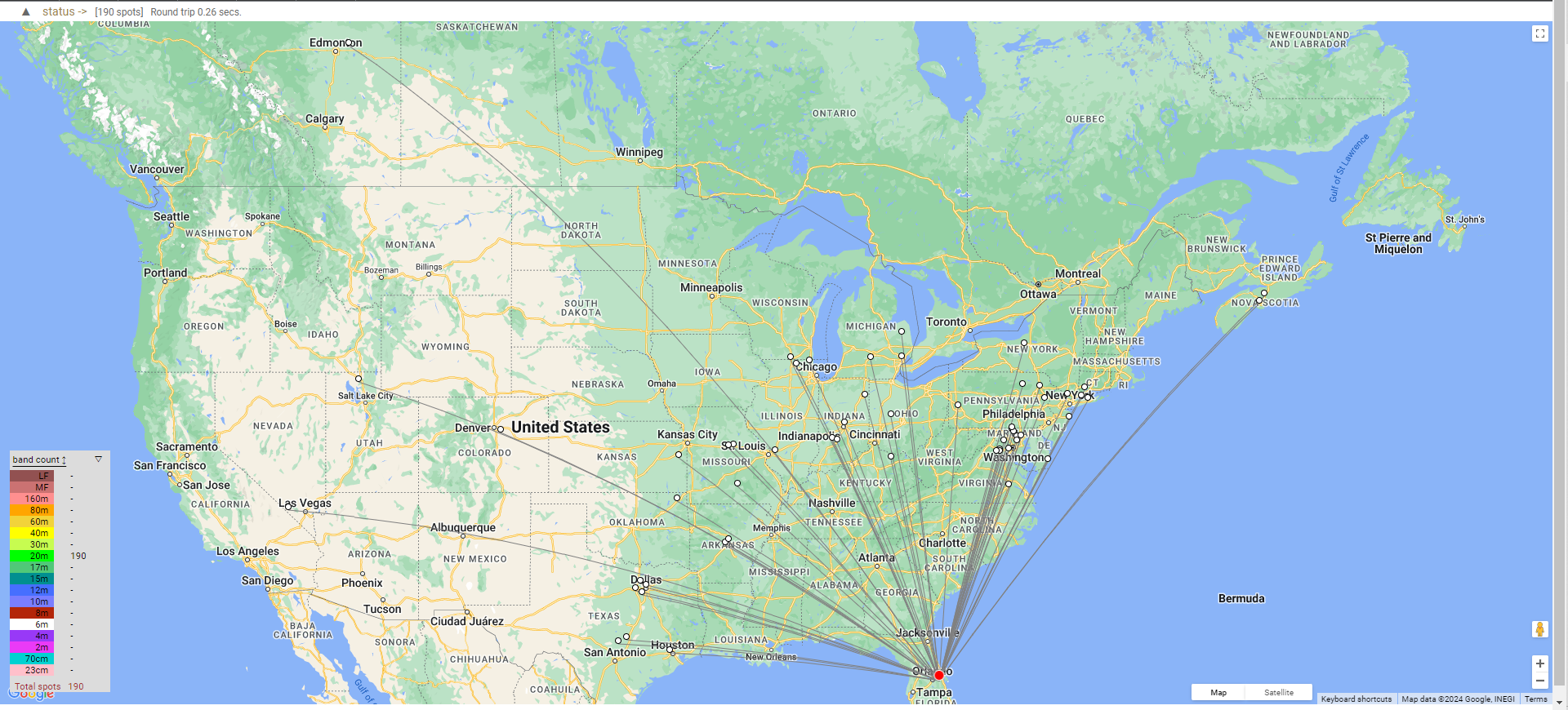
| TW 20M | 190 | -17 | 3808 | 1 |
| HS 20M | 121 | -18 | 3808 | 1 |
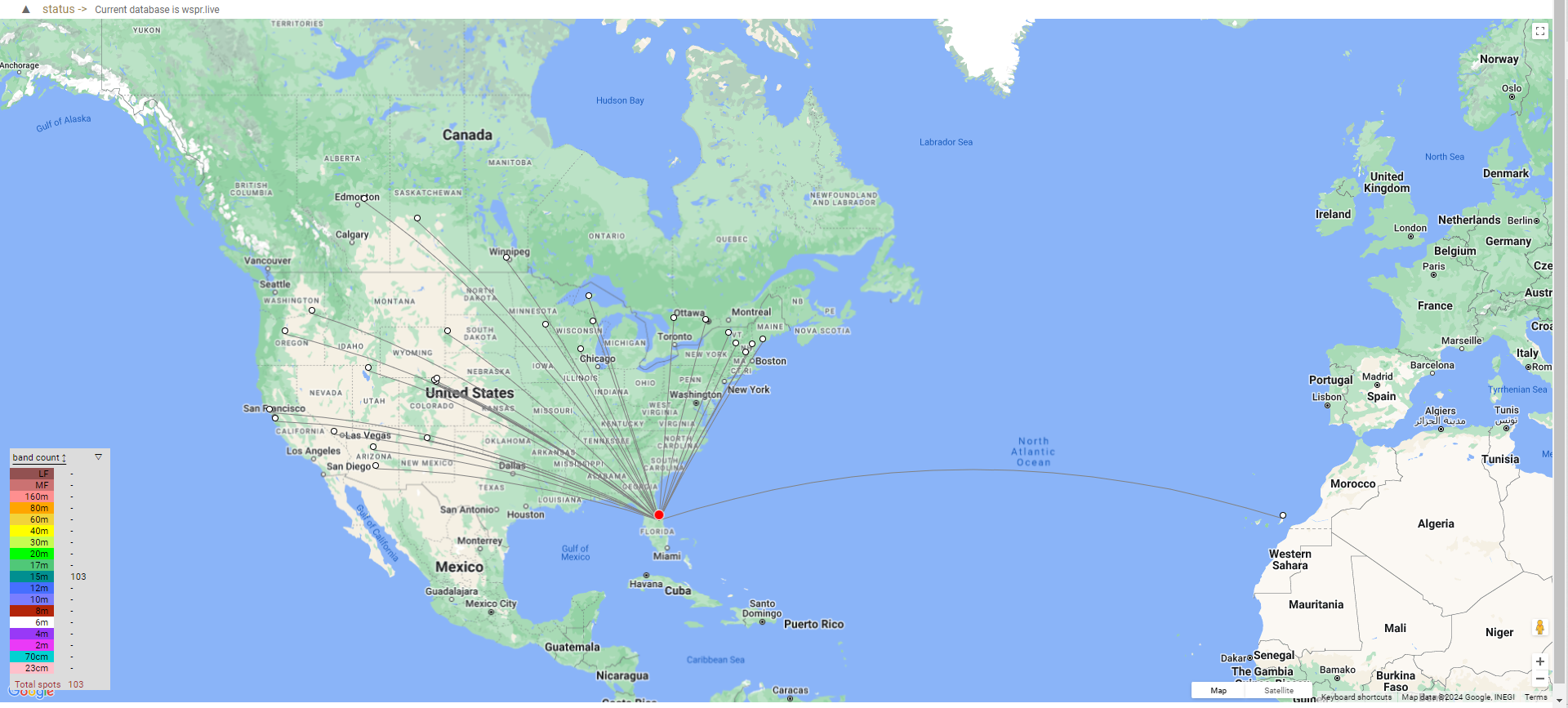
| TW 15M | 103 | -17 | 6466 | 4 |
| HS 15M | 88 | -18 | 6466 | 6 |
| TW 10M | 72 | -18 | 4251 | 3 |
| HS 10M | 50 | -20 | 4213 | 4 |
Counting spots, the TW2010 performed better than each comparable Hamstick. That’s not really a surprise since well tuned dipoles usually outperform 1/4 wavelength verticals. The margins for numbers of spots are 35% better on 20M, 15% better on 15M and 31% better on 10M.
As for reach, the Maximum Kilometer distances are almost identical, with outliers for both antenna versions. At max distance, the Hamsticks have more hits which seems a disparity from the overall spot counts. The SNR averages are only 1 to 2 dB difference, with the Hamsticks showing a stronger average. So, why is it they have a lower number of spots? Tis a puzzlement…
For the graphic record, here are 6 maps corresponding with the 6 runs.
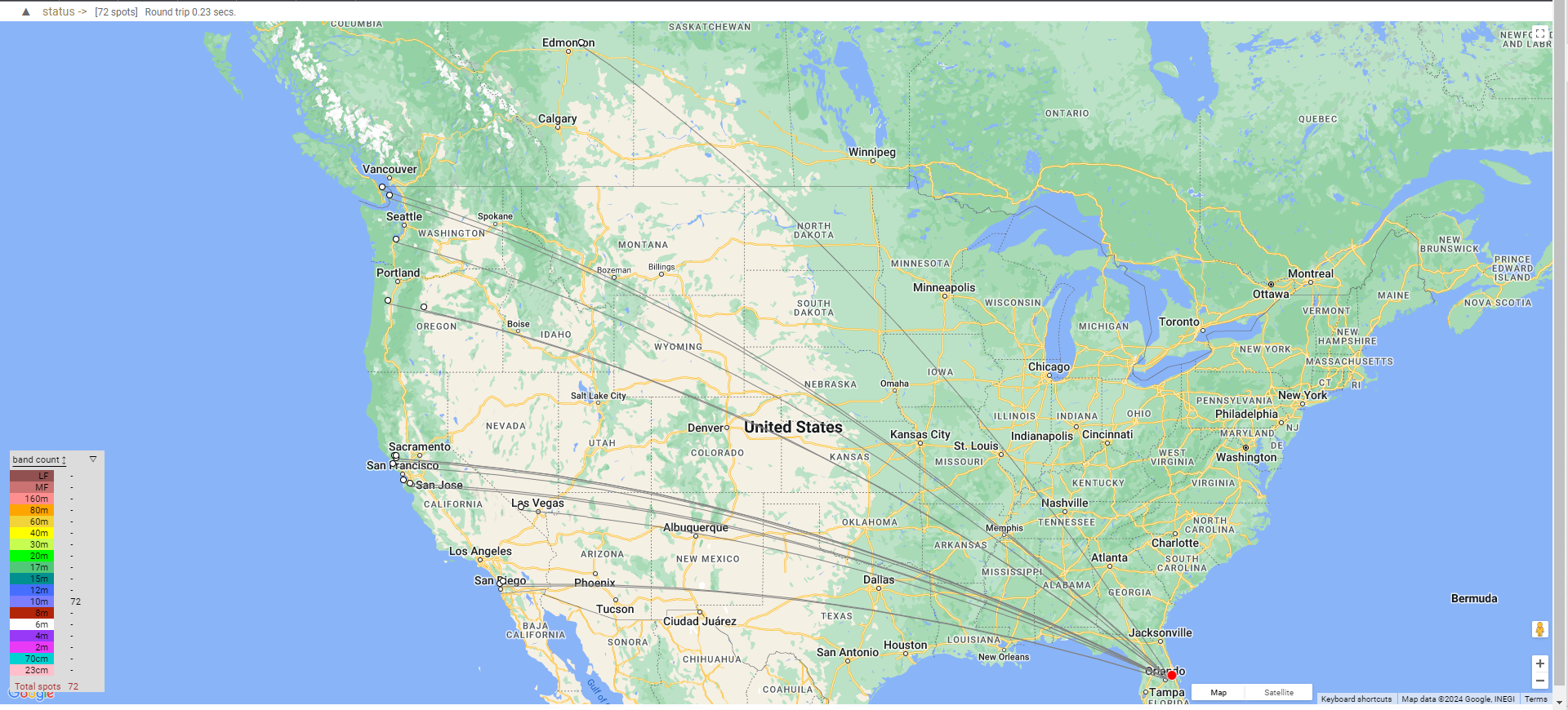
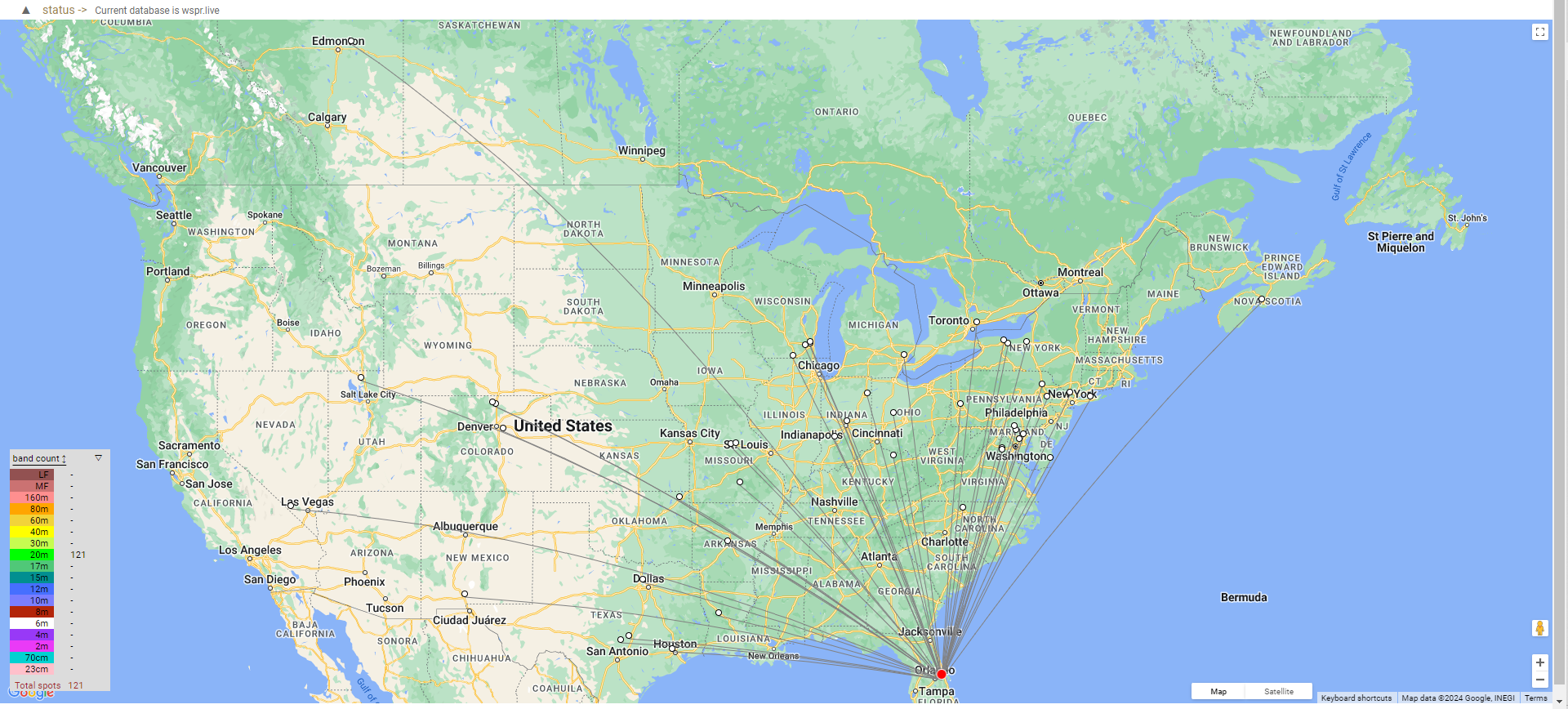
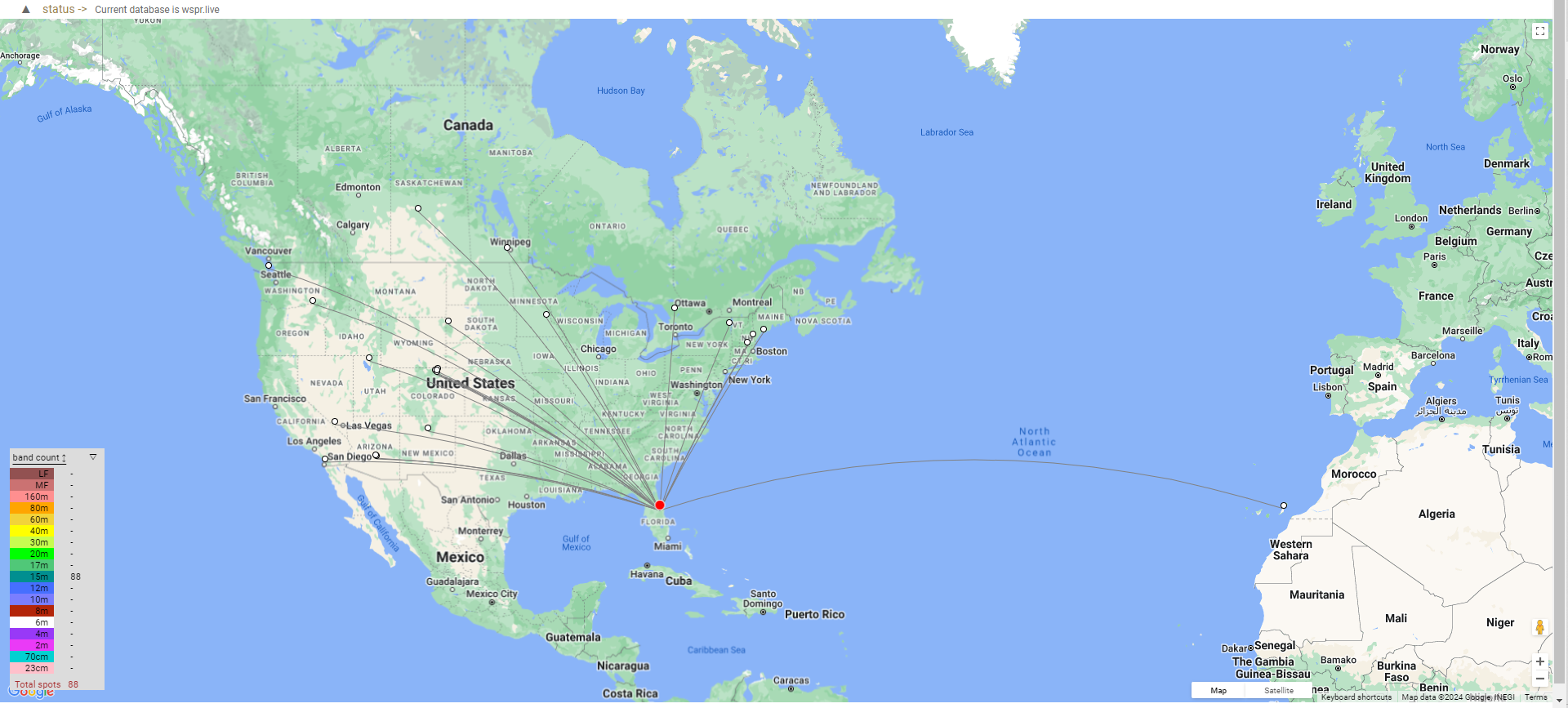
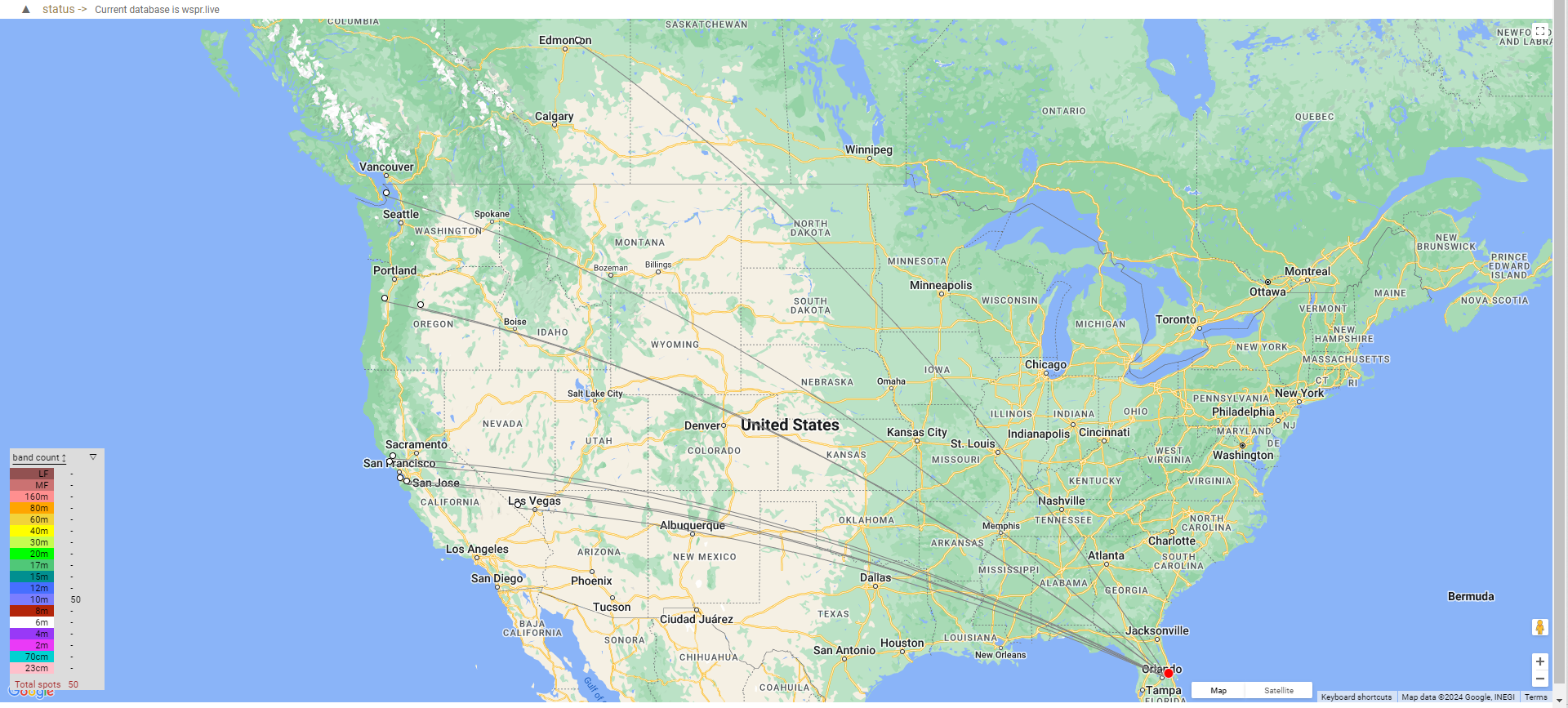
Turning from data to reality, I’ve made 6 QSOs from my Florida QTH to Oregon: 1 with the 20M Hamstick, 2 with the 20M TW2010, 2 with the 20M Wolf River Coils 17’whip, 1 with the 15M Wolf River Coils 17′ whip , most on different days, different times, different RSTs. so, yes all of these antennas “work.” 🙂
In the end, a subjective question remains: Is it worth paying about 6 times more for the TW2010 than for my collection of Hamsticks?
UPDATE 10/20/24: Two recent events happened recently with the TW2010.
- A QSO with Paul Butzi, W7PFB out in the woods in Washington state. I’ve been chasing POTA for a long time, and WA is a LONG way from FL. Paul and I made a faint QSO, via the TW2010 and my QMX on my end and 10W into a a Chelegance MC-750 on his end.
- The next day, frequency agility worked very well on the TW2010 as I made QSOs on all of its bands, 10m, 12m, 15m, 17m, 20m. Yes, I have Hamsticks for each of those bands, but band switching was easier with the TW2010’s “U” plugs, even faster than the Hamstick quick disconnects. Good propagation days and beautiful fall weather brings out POTA activators on all bands.
$888.95 for the TW-2010? Ouch! I think I’ll give the Hamsticks a try. 😉 Plus if you live in an HOA like me, it’s less noticable. Nice article.
Yes Vendel, it is “pricy.” Most days it seems not much different than a 1/4 wave vertical or the Hamsticks. Yet, it DID enable a recent 229 QSO from Central Florida to the middle of Alaska, using 3.6 watts. DX Engineering describes it as a “vertical dipole” with a low (27 degree) take off angle. What I can’t find from them are any modelling plots that show expected performance.
OTOH, my recent experience with the KJ6ER PERformer offers somewhat better performance than the Hamsticks. Maybe you can try it, not nearly as expensive? Yet, you will need space for the raised radials which are the real key to its performance.
I’v been using the 40m – 6m hamsticks since 2003. 20m is my goto HF mobile band and due to the narrow 40m hamstick band with (even with the WD4BUM IM-1 Inducti-mach coile), it’s my least operated HF mobile band. With each truck I’v owned, the hamstick is mounted to the left side of an aluminum drop in bed tool box, right behind the drivers side back glass with the base of the antenna a couple of inches below the top of the bed rail. With just 100w, I’v worked all kind of DX from the north Houston Tx area. More times then not when in QSO with a US state side ham when asked what my mobile set up is. Once they find out that it’s an IC-7000 at 100w into a 20m hamstick, the quite often tell me that my signal sounds like Im running a couple hundred watts into a beam at 50’. I’v had fantastic success using the 20m, 17m, 15m, 10m, and 6m hamsticks.
My current HF mobile set up is the hamstick mounted to the top of a fiberglass tonneau cover behind the drivers side back glass. I have lined the compleat bottom side of the tonneau cover with aluminum window screen that you can get by the roll at Home Depot. This make shift ground plane works quite well. I have 1.1 SWR across the full general SSB portion of 20m.
Back in 2007 – 2008 I was using a screw driver antenna. Doing a side by side test with the screw driver and a hamstick on 20m, 16 out of 20 stations said that my signal was stronger using the hamstick!
– KD5ITM –
Thanks for stopping by Tim. My results comparing an ATAS screwdriver with Hamsticks was similar to yours. QRP, and stationary operation, makes it far more noticeable. Keep havin’ fun!