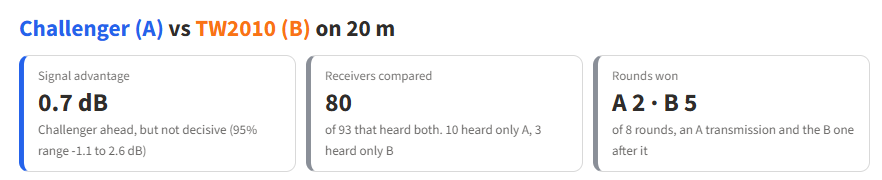
Assumed setup: A is Challenger and B is TW2010, switched after every transmission (16 transmissions from 14:36 UTC, order A B A B A B A B …)
Summary
Too close to call. Reach leans Challenger, heard by 103 receivers against 96, but not enough to call, and Challenger looks ahead by about 0.7 dB, but it could be anywhere from Challenger ahead by 2.6 dB to TW2010 ahead by 1.1 dB.
- 📡 Reach: 103 receivers heard A and 96 receivers heard B (10 only A, 3 only B, 93 both) — A heard by more receivers in 5 of 8 pairs, B in 3: within normal variation. Challenger leads, but if the two really reached equally, a split this lopsided in that direction would still happen about 36% of the time: suggestive, not enough to call it.
- 📶 Strength: Inconclusive: at the 80 shared receivers, Challenger looks ahead by about 0.7 dB, but it could be anywhere from Challenger ahead by 2.6 dB to TW2010 ahead by 1.1 dB. Challenger leads, but if the two were really equal, a lead this big would still show up about 21% of the time: suggestive, not enough to call it. A was stronger at 41, B at 28, tied at 11.
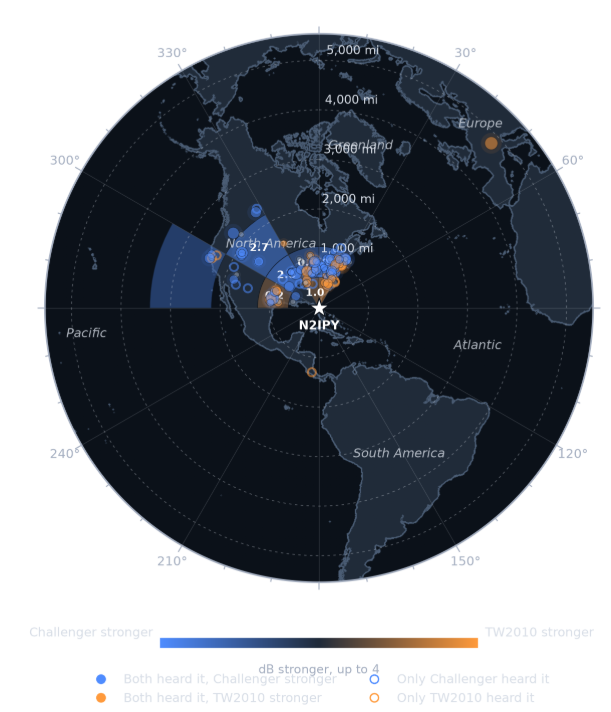
- 🌍 Similar farthest reach. Farthest receiver: A 4,815 mi (HB9ZHK), B 4,815 mi (HB9ZHK).
- 📏 By distance: no distance range stands out.
- 🧭 By direction: no direction stands out.
- 🔁 Consistency: over 8 rounds of A then B, A was stronger in 2 and B in 5. A mixed record: propagation moved around more than the antennas differ.
⚠️ Only receivers that were on the band during both sides’ transmissions are counted (106 of 142): they decoded other stations in your transmission slots. Many WSPR receivers hop between bands and are on this band only in some time slots, which would otherwise look like one side reaching more.
Leave a Reply