Archive for the ‘workbench’ Category

Goodell-Pratt Eggbeater

Friday, October 2nd, 2009

I found the Goodell-Pratt number 5 1/2 eggbeater drill at Liberty Tools in Liberty, Maine. Liberty Tools is a galoot’s paradise where one has little choice but to spend money. This drill went for $28. We put it to use immediately at the Wooden Boat School, drilling and setting screws on the boats we were building. We quickly discovered that it’s a very versatile drill. In addition to the usual drilling action, there is a fast / slow selector that alternates gearing ratios. The fast speed is great for drilling pilot holes and most screw setting. Switch to slow when more torque is needed. Then, there’s a ratchet mechanism too. See the R I L indications on the round plate under the hand crank? R and L set ratcheting for Right or Left. The I setting locks up tight, no ratcheting. This makes the drill very handy for working in tight spaces where’s there not enough room to fully spin the crank. Quite a nice eggbeater!

Other than wiping the handle clean so it didn’t stick to my hands, the way shoes stick to the floors in movie theaters, we did no other clean up. There is a patent date of Aug 13 1885. The next patent date found on that model drill is 1905. So, this one was manufactured sometime between those two dates. It had a fair amount of grunge, but not bad enough to affect smooth operation. We used it at the school. I then brought it home and used it in building a workbench and the first boat. Still no clean up. (Click the picture on the right to see 100+ years of “ambiance.”)

photo of goodell-pratt eggbeater photo of eggbeater in use

Being between projects, I’m following Stephen Covey’s habit #7: Sharpen the Saw. Actually, the saw was sharpened last week. This week I refurbished the eggbeater. Here’s where the traditional collectors will howl. Instead of doing the minimal (don’t harm the patina) restoration, I stripped it down, polished, and repainted. It’s not a collector’s item. It’s “a user.” So, I’m not worried about the howls. Three coats of fresh paint went on the metal parts. a new side knob of mahogany replaces the one that was lost. A bit of red stain brought the knobs and handles into harmony before receiving three coats of Minwax Polycrylic satin finish. Polishing the bare metal parts brought back their luster. One of the compression springs inside the chuck was badly deformed. I wound a new one from the steel core of a well used guitar string. (Don’t ever throw away used guitar strings.) Lubed and reassembled, the drill runs as smoothly as one could want, and looks almost as nice as Wictor Kuc’s. Ready for another hundred years.

photo of refurbished eggbeater photo of refurbished eggbeater

Update: A discussion over at the Sawmill Creek forums has Mike asking about the speed shifter on a Millers Falls drill. Although different in how the speeds are selected, I’m guessing the internal mechanism is similar. Following are 4 pictures showing my cautious step-by-step disassembly of the shifter. It turns out to be a simple device. The internal sleeve has ears on each end and is keyed to the collet shaft. Those ears engage either one pinion or the other. The little shift wheel on the frame moves a peg that slides the sleeve to one pinion or the other.

shifter disassembly 1 goodell pratt speed shifter 2

goodell pratt speed shifter 3 goodell pratt speed shifter 4

Small Boatbuilding Hand Tools

Wednesday, September 9th, 2009

Over at the WoodenBoat Forums, a newcomer asks about hand tools for small boat building. I don’t know exactly what he considers small, a dingy or canoe, or a small Trumpy. I do know, however, a lot about the tools I used to build the Fiddlehead canoe. This list worked for me and might work for other amateur boat builders. (I doubt professionals would easily give up using power tools, which they think do the work faster.)

Bench and bench accessories

benchIt’s the single most used tool in the shop. Mine is a 12 foot long “English Bench” taken from Chris Schwarz’s book “Workbenches from Design & Theory to Construction & Use.” The 12 foot length is comfortable for the size of the shop and is suitable for planing boat lumber up to 16 feet long (with some lumber shuffling of course). The bench dogs, full width planing stop on the end, and the bench hook are all shop made accessories. The Gramercy holdfasts are from Tools for Wood Working. The bench is further described in a series of blog entries.

Layout

layout toolsMost work starts with some sort of layout. Starting at the left edge and proceeding roughly clockwise, we have:

  • A shop built marking gauge with two beams, one for pencil, the other for a scribe. It is made of cherry and roughly to a plan found here.
  • The black plastic bodied compass / divider is an AccuScribe, which can be found at a number of woodworking tool outlets.
  • The compass / divider I like more is the vintage 8 inch Bemis & Call steel compass found in an antiques shop in Liberty Maine. Cost = $10. It once belonged to someone named C L Beckett who stamped that name on each leg.
  • The oak thing is a shop built center marking gauge, handy for resawing.
  • A utilitarian 25 foot Stanley rule.
  • A chalk line is useful for marking long rip lines on lumber. Strictly for rough cutting.
  • A utilitarian try-square, a couple of small machinist squares, and a 6 inch rule.
  • Two bevel gauges, one an ancient Stanley #25 (from Sandy Moss I think), the other shop made from a hacksaw blade and a rivet.
  • Lastly, a very fine Pattern Pilot marking knife from Bob Zajicek at Czeck Edge Hand Tools. It is probably more useful for cabinet makers than for boat building, but is a gorgeous tool nonetheless.

Planes

planesAll of my planes are refurbished vintage planes. Over the life of any sharp edge tool, one will sharpen it many many times. Sharpening is an essential skill and is not difficult to master. In my view, knowing all you can know about a tool, including how to refurbish it, is only an incremental step beyond sharpening. I like to refurbish tools, bringing them back to life and putting them back to work. I am careful in what I buy and where I buy it in order to make the most of what I refurbish. My planes include (left to right):

  • A Stanley (Bailey) #7 Jointer plane. Type 16 (1933-1941) with 1935 iron. From Jon Zimmer. $145. While in Maine, I roamed the antique tool stores and found dozens of these for prices in the $70-$80 range. Each and everyone had a flaw of some sort that ruled it out. I eventually found this one from Jon, and don’t regret paying him more for finding a better tool than I could find by wandering around.
  • A Stanley (Bailey)#5 Jack plane. Type 16 (1933-1941) with 1935 iron. From Jon Zimmer. $120.
  • A Stanley (Bailey) #3 Smooth plane. Type 15 (1931-1932). From Jon Zimmer. $80.
  • A Stanley #60 Low Angle Block plane. Circa 1900. From Sandy Moss. $50.
  • A Stanley #40 Scrub plane. Circa 1910. From Jon Zimmer. $80.
  • A Sargent #79 (copy of Stanley #78) Fillister and Rabbet plane and accessories. Circa 1925. From Sandy Moss. $35.
  • A Stanley #51 Spoke Shave.  Circa 1920. From Sandy Moss. $20.

I’m sure there are trustworthy vintage tool dealers on Ebay, but I haven’t found time to sort them out of the world’s largest yard sale.  Likewise, I haven’t found all of the trustworthy dealers on the internet. However, I do trust and have done business with each of these folks: Jon Zimmer, Patrick Leach, Sandy Moss, Walt Q, and Bob Kaune.

For those who have not refurbished an old plane, Bob Smalser’s excellent tutorial will get you started: “Rehabilitating Old Planes

Chisels and shaping tools

chiselsThere are surprisingly few. The bench chisels are Narex. They were surprisingly inexpensive (less that $30 for the set of 4), and surprisingly good. It’s all about good steel, and these are tough and hold their edges very well.

The little carving chisels were for carving the fiddleheads on the ends of the boat’s stems. They are not of high quality steel, so I won’t reveal their pedigree.

The only other shaping tools I use are a Stanley Surform and a half-round cabinet maker’s rasp.

Oh yeah, and sandpaper.

Saws

sawsSome are store bought. The yellow handled Stanley has carbide teeth and works OK. I use it only for rough cross cutting. There aren’t a lot of high-precision straight cuts in boat building. Hey, we’re making boats, not grand pianos. A simple hack saw does the metal stuff. The little razor saw is handy once in awhile.

My real workhorses are shop made. The big frame saw was cut down from an antique Disston D-8 rip saw, and made roughly to Josh Clark’s design. I use it for ripping long lumber, and for resawing. Resawing is so valuable for boat lumber; getting two (or more) boards for the price of one is wonderful. See my resawing tutorial for more. The bow saw is a delightful, lightweight, highly maneuverable saw made from plans found at Gramercy Tools. I use it constantly and can’t say enough good about it.

Good learning resources for rehabilitating and sharpening saws are:

Drilling

drilling toolsMy Goodell-Pratt #5 1/2 B , eggbeater sees constant use, for both drilling and screw tightening. It dates to about between 1886 and 1905. I found it at Liberty Tools in Liberty Maine, for $28. Liberty Tools is a real neat place, but you have to go there; no mail or Internet ordering. The drill was, as most are, missing the side knob, which I fabricated. It has two speeds, and a ratcheting mechanism that works in both directions. It’s almost as fast as other hand drills, is a lot more accurate (no overrun), and doesn’t ever have dead batteries.

The Stanley #923 brace does the heavier work. It wants to have square shank bits for the best work. It came from Walt Q for $25.

I find the Fuller bits indispensable. There are hundreds (sometimes thousands) of screws used in boat building. Most are silicon brass and are known to fracture easily if not fed into the right size hole. Every screw hole is prepared with one of these bits. Screws are also waxed before driving. I have had no breakage problems.

Other stuff

clampsA few dozen odds and ends include screwdrivers, pliers, and not nearly enough clamps. The orange and blue clamps are from “the Borg.” The lap clamps are shop made and did exactly what they were made for.

All in all, that’s not very many tools. A small collection can do a lot of work.

Oh yes, there was one electron murdering tool used for building the boat. Before I built my frame saw and bow saw, I used a Rigid 14 inch band saw to cut the inner stems and to resaw a few strips of cedar for the laminated bulkheads. Since those cuts, and after making the new hand saws, the only use I’ve had for the band saw is quickly cutting waste wood down to disposable size.

Building the Fiddlehead’s Bottom on the Long Bench

Wednesday, November 12th, 2008

The best reason for this post is to rave about how well the long workbench works.

The Fiddlehead’s bottom is made of three pieces of edge joined cedar, finished to 9/16″ thick. The center board is 11 feet long. The edge boards are each 8 feet long, and everything fits easily on the long bench.

The front apron is especially helpful for jointing the edges. Each of the boards had one face surfaced as a flat reference surface. Then, they are clamped on the apron in the correct relationship and their edges jointed together. Jointing them together ensures their edge angles match. The quick set up on the apron makes it easy to release and flip the boards up onto the bench for test fitting, and then set back up for fine tuning. I found it surprisingly easy to get to a “sprung joint” that was tight on the ends and about 1/32″ open in the middle.  One clamp in the center was enough to produce evenly distributed squeeze-out during glue up. About as close to perfection as one can get, and it took surprisingly little effort. Yet, I did actually use more than one clamp, just to be certain. The primary thing holding the bottom of the boat together is these edge to edge glue joints.

The shop temperature is near the minimum for West System epoxy, so I let it cure a full 24 hours before moving on to thickness planing.  Two dogs, two holdfasts, and a couple of turns on the tail vise gets the piece set up for planing in about 10 seconds. Plane one side for a while. Flip it, and plane the other side. Rinse, lather, repeat until we get to 9/16″. The big ole heavy #7 is rank set for a moderate cut; reasonably good material removal with no tearout.

Workbench: Done

Tuesday, November 4th, 2008

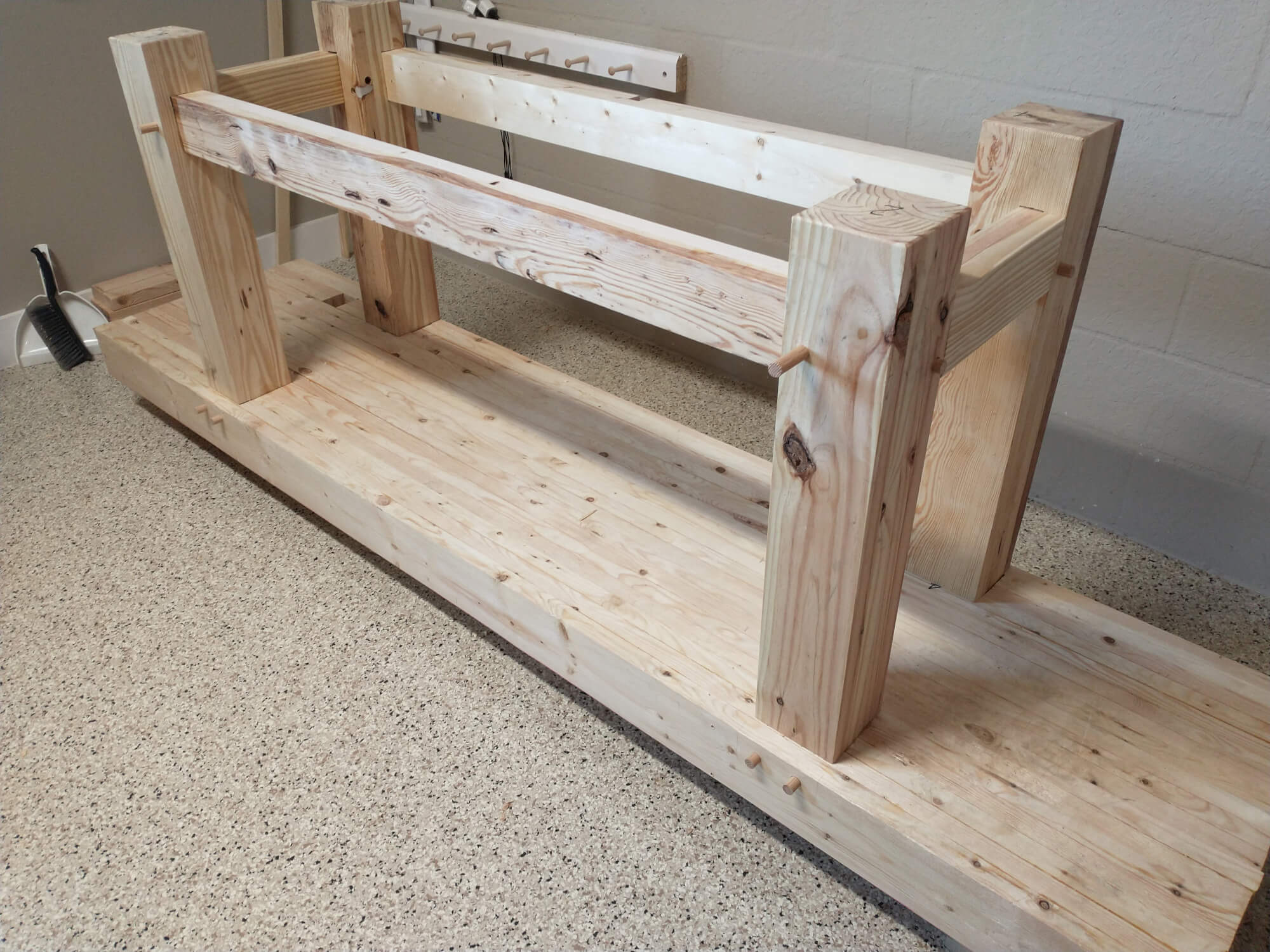
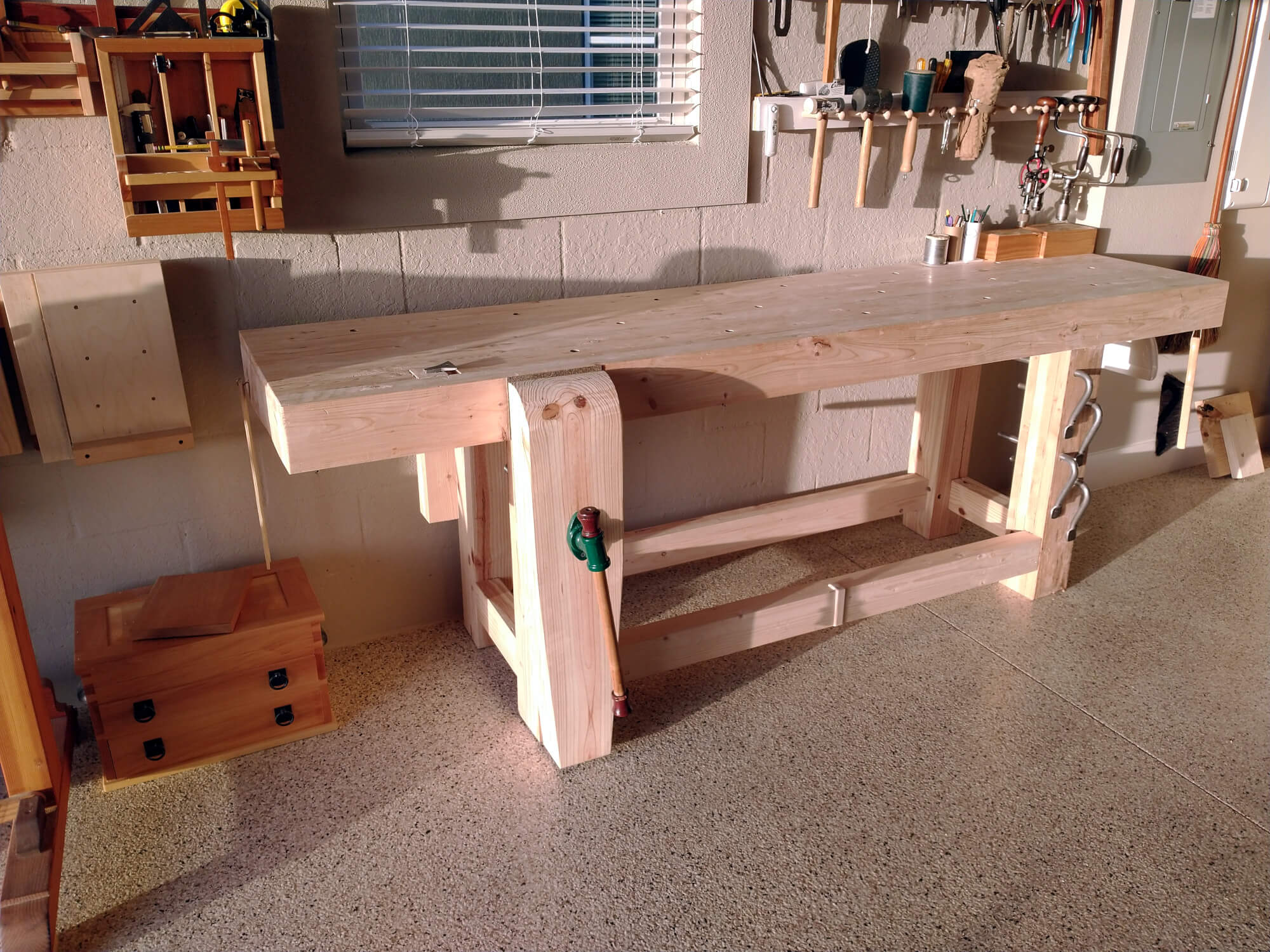
My extra long “English” workbench is done. The plan came form Christopher Schwarz’s excellent “Workbenches from Design & Theory to Construction & Use.” I lengthened it to accommodate the longer workpieces commonly found in boat building. It is 12 feet long and 2 feet wide.

Although made of common construction lumber (aka rather ugly Douglas fir), and with a thin top compared to some cabinet builders benches, it ends up being rock solid. While contemplating extending the length, I asked Chris if he thought a third set of legs would be needed. He suggested they wouldn’t hurt and pointed out a photo in his book of a bench with three sets of legs. I took a cautious approach and made the center legs a fraction of an inch short. The last thing I wanted was a teeter-tottering bench. Well, there’s no teeter-totter, and not much we can do to make those legs touch the floor. Maybe if I plop my truck engine on the bench? This is what they invented wedges for, isn’t it!

The Gramercy holdfasts from “Tools for Wood Working” work very well. They do need a top thicker than what I used. So, like I did for the dogs, I added doubling blocks under the holdfast locations. They’re great tools at an attractive price.

All of the lumber dimensioning and most all of the fitting and construction was done with hand tools. The only things I used electrons for were:

  • My old $10 hand drill helped with the large holes for the lead screws for the vises. As an aside, this is an amazing drill. It was a “no name” metal bodied $9.95 special in the early 1960s. I’ve used it almost continuously since them for the usual DIY stuff.  It has outlasted two cordless drills and shows no signs of giving up.
  • I used the band saw to nibble away the waste near the curved areas of both vise faces.
  • A semi-retired miniature lathe and some idle mahogany were used for the ends of the vise handles.

Building the bench offered a few really interesting techniques: the use of Miller dowels for fastening the top (no metal to catch a plane while flattening), the use of drawboring to really tighten up a mortise and tenon joint, and the use of a wedged tenon for the parallel guide at the bottom of the face vice. Each technique was easy to learn, thanks to well written instructions, and each produces very strong joints.

Two coats of boiled linseed oil provide enough finish to keep blood from soaking into the top. Don’t ask how I know that.

Also: “approved by the Schwartz.”

Now, back to boat building.

Workbench: Flattening the Top

Thursday, October 30th, 2008

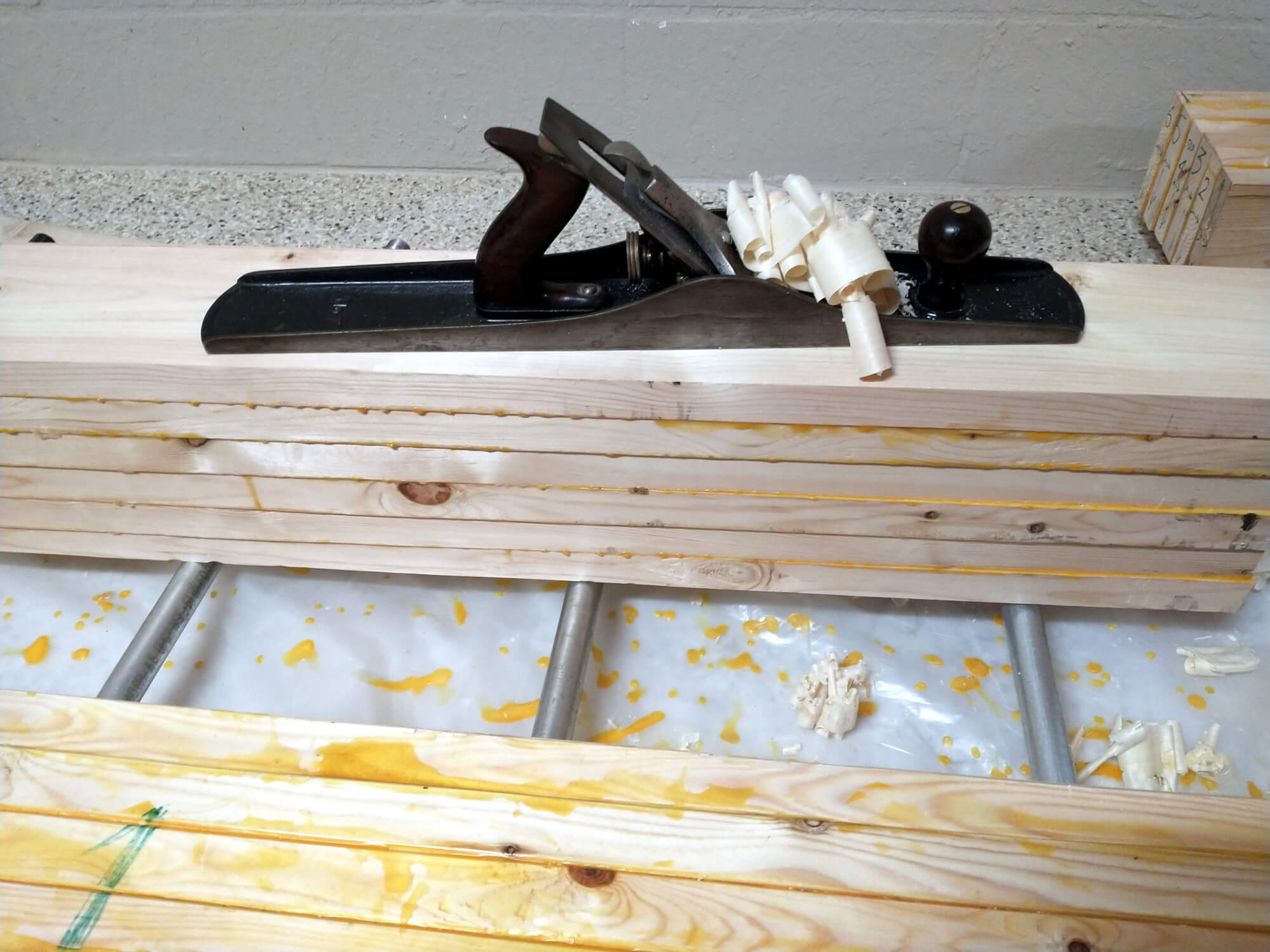
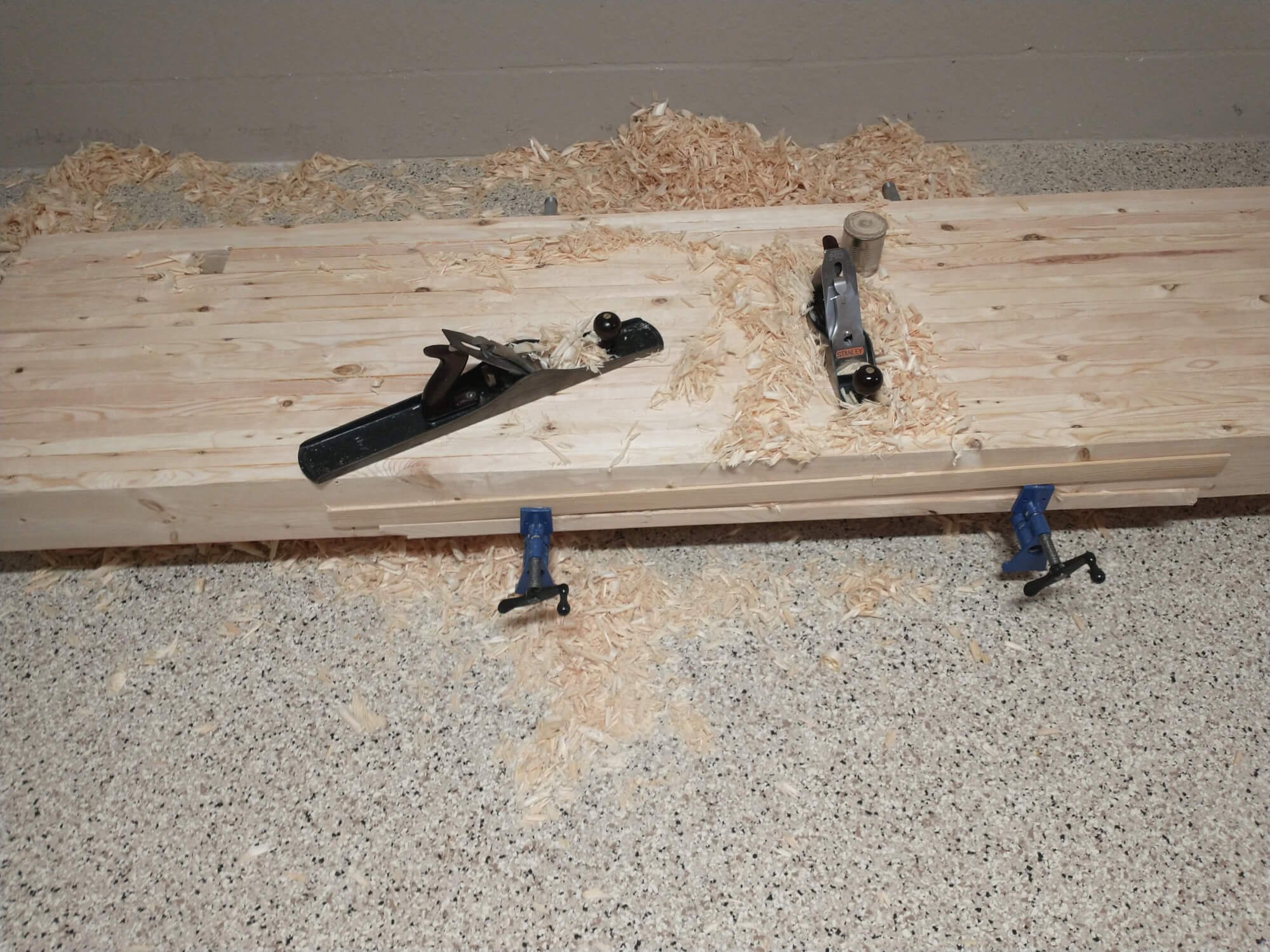
rough flatteningbig pile of shavingsThe last two boards are on, bringing the width to 24 inches. Flattening is simple; just takes time and 2.3 Snicker bars worth of energy. The big ole No. 7 jointer was set up rank and swept diagonally until all boards were brought to the same thickness. I then set it for fine work and used along the length of the boards to remove the diagonal marks. The heft of the jointer, along with a razor sharp iron and a constantly waxed sole (candle wax), makes it a very effective and enjoyable tool.

whispy shavingsThe No. 3 smoother feels petite in comparison, and was set up for petite, lace like, finish work.

The keen observer might find some strange holes in those last two boards. No, they’re not for holdfasts. Those boards each had a few dead knots in them, the kinds surrounded with a black ring of bark where the tree grew up around dead branches. Those kinds of knots tend to be loose, and in boatbuilding they must be removed and plugged lest they become unplanned drain holes. Here, I just knocked them out and left them unplugged. Made planing easier.

It turns out to be exactly what I expected. Al Navas would want better, but this is perfect for its intended use and a good bit better than what I’ve seen in many boat shops.

Workbench: Going to the Dogs

Tuesday, October 21st, 2008

bench-dogsEvery respectable woodworking bench has dogs and a vise for clamping work against the dogs. There are several styles of dogs commercially available. Most of them are metal, and I prefer keeping metal as far away from my plane irons as possible. I decided to make, rather than buy, my dogs and settled on 1 inch square dogs made from ramin hardwood square sticks that are readily available at the home center.  The spring leaf for each dog is 1/8 inch thick cedar, leftovers from a little resawing project. A notch is cut for the leaf along one side of a dog, and then a cabinet maker’s rasp cuts a short angle at the end. A brass screw attaches the leaf. I borrowed the design from Stephen Sheppard.

OK. Next we need holes for the dogs, and a vise. Two boards were use to form the holes, one to hold all 25 dog holes, and the other to close them. Since this bench has a thin top, the depth of the dog holes is doubled by gluing another board below, making the bench twice as thick along the row of dog holes. All holes were hand sawn and chiseled. They are remarkably similar in size.

The vise is a very simple Lee Valley front vise that I’m using as a tail vise. The face block for it holds the moveable dog.

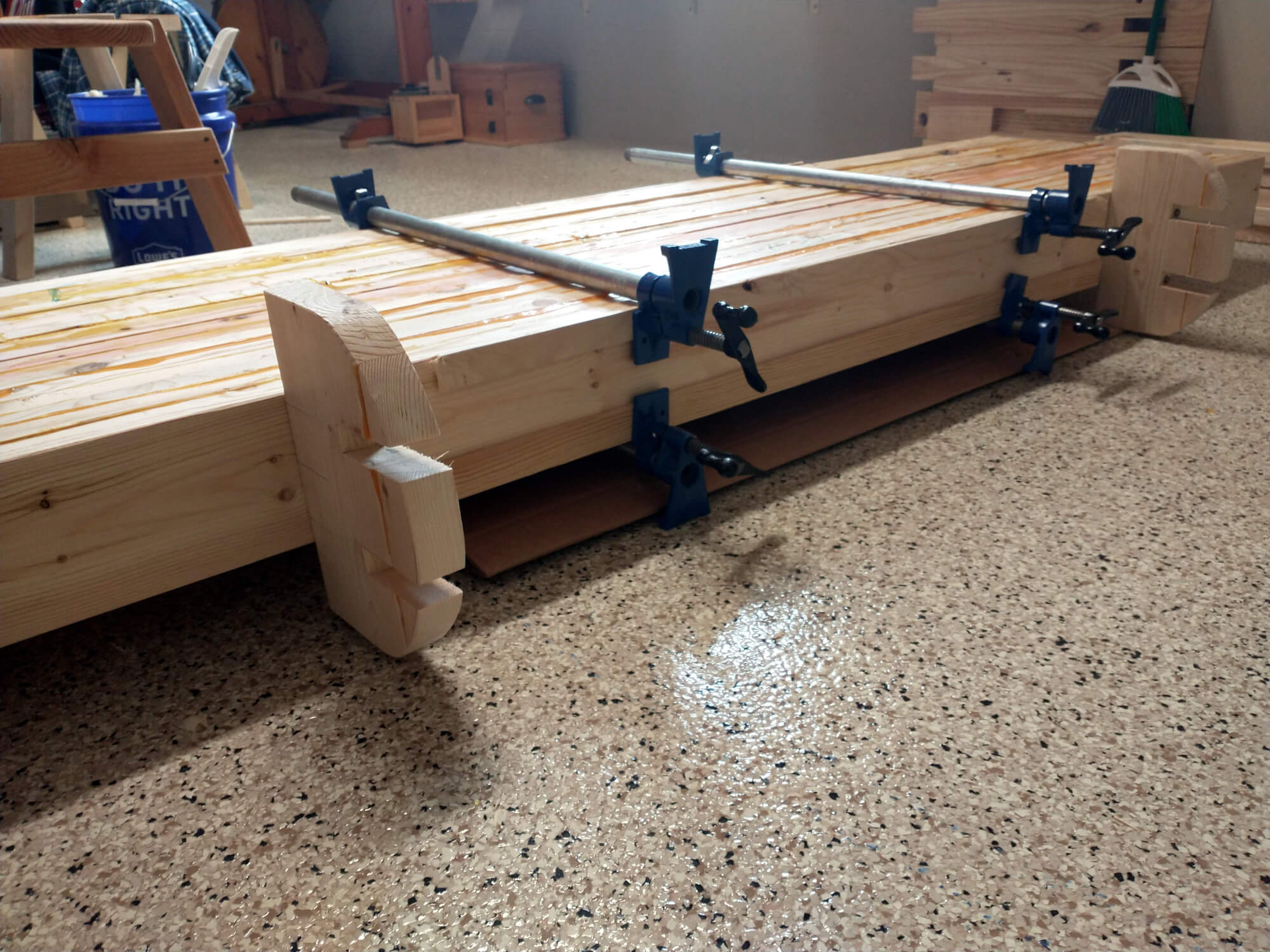
two boards, dogs, and viseThe usual procedure for building a bench is to glue up the entire top all at once. I have strayed from that path for two reasons. First, I don’t have a reliably flat reference surface 12 feet long that I can use for the glue up. Second, I imagine that the accumulated weight and length would make the complete top heavier than I can manage alone. So, I’m adding a board at a time directly to the bench frame. Attachment is a combination of glue and Miller dowels.

There are a lot of rough edges at this point: the top surface of the boards are not even with each other, the boards are slightly over length, and the vise face needs trimming both on the top and on the side that ajoins the apron. All will be resolved when the top is complete. Way down at the other end is a 2 inch by 2 inch planing stop, made of the same ramin as the dogs.