Shhhhhhhhhhhhh is the wonderful sound a perfectly sharpened gouge makes when sliding through wood.
It is also the sound that applies to recent carving projects … until after an upcoming holiday.
Chocolate powered woodworking
Shhhhhhhhhhhhh is the wonderful sound a perfectly sharpened gouge makes when sliding through wood.
It is also the sound that applies to recent carving projects … until after an upcoming holiday.
If you are a woodworker, and have not been asleep, you’ve heard that the Consumer Product Safety Commission (CPSC) appears eager to mandate all table saws include flesh sensing technology? Yes, their pre-rulemaking comment period is open right now and they need to hear from you.
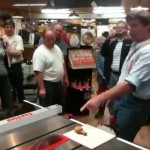 The issue is reducing injuries due to table saw accidents. Admirable! It’s certainly a good thing to do and there’s no question that saving fingers and hands is always preferable to any alternative. Yet, how?
If you’re an avid woodworker, you’ve probably heard of the brilliant SawStop technology. Maybe you have seen videos of how it works. It is amazing!
You might also have heard of “Osorio versus One World Technologies,” a court case in which a person was seriously injured using a table saw. They have both come together in an interesting way, and now the CPSC is riding in on a white horse to save us all from ourselves.
The whole story is many thousands of pages long, so I will offer only the barest of facts as I know them. Yes, I have my own opinions and, yes, you will find the information I present biased. There’s a big pile of links at the bottom of this posting.
Let’s take the SawStop part first. Here are only a few of the things we know:
HR 4782 and HR 4783 were both proposed by Congressman Wu from Oregon in 2007-2008. [SawStop is headquartered in Oregon. Who knew?!] I have not determined if either passed. The bureaucratic swamp is very deep and murky.
Along comes Mr. Osorio. He couldn’t find employment in the computer field, his chosen field in which he had obtained training and education. To fill the gap, he accepted a manual labor job with a flooring contractor and unfortunately suffered a serious injury on that job.
Here are a few of the things we know about Mr Osorio:
Now, we have the CPSC active again. Was the Osorio case the trigger? If it was, the CPSC isn’t saying. Read on and you’ll know why.
The CPSC is one of three (are there more?) large agencies that craft regulations regarding safety: Occupational Health and Safety Administration (OSHA) – a U.S. federal agency, Underwriter Laboratories (UL) – an independent organization that if if did not exist would today be created as a U.S. federal agency, and of course CPSC – a U. S. federal agency. OSHA tends to hover over things “occupational,” that is, employment related. UL sees a huge domain of things that are technical. CPSC holds its umbrella over things “Consumer” oriented. Clear? Got it? Yeah, I thought so…
The CPSC has now started moving vigorously on the table saw safety matter. Actually, no government agency moves vigorously, but this time slightly faster than before. They have issued two documents. The first part of one is nearly identical to the whole of the other: a Table Saw Blade Contact Injuries briefing package and an Advance notice of proposed rulemaking. They look like the same information packaged in two different formats. Read one of them.
Here’s what I get from reading their documents:
As you have already figured out, I oppose the CPSC action. I’ve been very careful about not introducing politics in my blog, but to me this has a political aspect that I abhor. Our founders created a magnificent representational republic. They designed it with divided powers, with checks and balances, that keep each of the three major branches in balance. No one should become so powerful that another cannot correct the imbalance, and none shall go beyond the power of the people. If the Congress does things we don’t like, we can throw the bums out. If the Executive does things we don’t like, we can choose another in 4 years. If the Judiciary does things we don’t like, we can revise or replace the laws they interpreted differently than we like. The power is with the people. The government works for us and we can and should hold them accountable.
That works … until it becomes imbalanced … and until some become powerful beyond the reach of accountability. Long ago, Congress started establishing federal agencies and imbuing them with regulatory power. Maybe this was to outsource the nitty-gritty details of “implementing” laws. Maybe it was to protect members of Congress from making hard choices that might cost them their jobs. Who knows? The number and types of these agencies has grown, and their powers have grown. Today, we are seeing as much “law making” activity form the agencies as from Congress … and they are largely unfettered. They are certainly not elected, do not represent “We the People” and are not accountable to the people. They determine what needs to be done in our interest, sometimes ask us about it, and then go on and do as they please. (Did you know that many of these agencies have their own armed enforcement branches, and their own courts that are not accountable to the Department of Justice?)
OSHA, HUD, EPA, CPSC are only a few of these agencies, and I’m sure you’ve heard stories about them that strike your own nerves. Here are a couple of recent CPSC escapades that have come to fruition since they got their moxie back (in the form of 3 Democrat commissioners and 2 Republican commissioners):
And we want these same people to make table saws safer?
BTW, the CPSC is an unwashed amateur when it comes to issuing regulations. They can’t hold a candle to the EPA. The CPSC isn’t telling is what toilets we can have, what light bulbs we can use, what fuel and engines diesel trucks and use, and on an on.
I don’t have a table saw. Had one once, about 30 years ago, a Craftsman benchtop saw from the era when Crafstman was still making decent tools. The saw was very useful for a few projects, and I went to great lengths to learn how to use it safely. I never had occasion to make those “special cuts” that require removing the safety guards. Once the nature of my projects changed and the saw sat idle, I sold it and haven’t wanted one since.
I believe that safety is an individual responsibility and that every individual is responsible for their own safety. Mr. Osorio should have known how to safely accomplish the rip cut he needed to make, or, instead of using more force, he should have stopped to learn when the going got tough on the first attempt at that cut. Some say his employer should be held to account for ensuring the training was thorough. I can’t address that since I have not read the original trial transcript and don’t know if there was other litigation or compensation. In the end, we are responsible for our own safety, and our own choices. [No, I won’t go down that path that since “society” shares the costs of remediating Mr. Osorio’s accident, “society” can set the rules for what tools he gets to use. That’s a whole other huge can of worm infestation.]
Were I to need a table saw now, I want the freedom to purchase the capacity and features I want, not those that some bureaucrat has decided for me. Were I operating a facility where many people would use the saw, I would want them to all be as safety conscious as I am, and I would be dictatorial about it. Yet knowing that some won’t be as careful as I expect, and knowing that we have the highest density of lawyers in the world, I would probably purchase a SawStop saw. Were my needs for frequent and heavy use, I would probably buy a SawStop because I recognize that both over-familiarity (a variant of carelessness) and tiredness are hazards that lead to accidents. Were I to be the sole, and infrequent user, I most likely would not purchase a SawStop. It’s the freedom of choice that interests me, not the control of an unelected, unaccountable, bureaucrat.
Note: comments are limited to 2000 characters. I couldn’t fit in all that I would like to say, so I said the following:
The briefing document (http://www.cpsc.gov/LIBRARY/FOIA/FOIA11/brief/tablesaw.pdf) completely fails to persuade that a mandatory rule is required.
Historical incident data are suspect due to calculations which extrapolate 846 into 78,000. (p16)
More recent incident data, as related to the effectiveness of UL 987, is non existent. Making decisions without knowing UL 987’s effectiveness is irresponsible.
The briefing reveals that too little is known. The list of information requested shows the CPSC has significant information voids.
More disturbing is the nature of how this potential ruling has evolved. Mr. Gass, the inventor of a highly effective technology seeks monopoly power. He has surrounded his invention with dozens of patents, obviously attempting to seek royalties, if not infringement judgments, from as much of the relevant industry as possible. He has attempted and failed to sell his technology to many major power tool producers. Failing to persuade major manufacturers, he has attempted to have the U.S. Congress legislate the use of his technology. That too failed. Now he seeks legislation through the CPSC, an Executive agency. His technology is available in the open market, and is being accepted by those who value it, exactly as it should be.
The potential ruling is inappropriate because it:
– seeks to make rules with insufficient information
– seeks to add rules to those already made by OSHA and UL without understanding recent changes (UL 987)
– seeks to relieve individuals of their own responsibility for practicing safe procedures
– seeks to impose burdensome costs
– seeks to grant monopoly power to a specific very expensive technology or individual
– seeks to ignore our well reasoned representative form of government. Congress has determined not to favor this individual or his technology. Why then should an unelected body, that is not accountable to the American public make such a mandate?
You can let the Consumer Products Safety Commission know what you think of their proposed rule making? Do it before Dec 12 at: this form.
(P.S. Also be aware that attempts to submit using Firefox fail. Use Internet Exploder for successful submission.)
—–=====*****=====—–
The Constitution is not an instrument for the government to restrain the people, it is an instrument for the people to restrain the government, lest it come to dominate our lives and interests.
– Patrick Henry
—–=====*****=====—–
CPSC Comments form
Table Saw Blade Contact Injuries briefing package
Advance notice of proposed rulemaking, CPSC
About the CPSC, a list of Commissioners and other information
Commissioner Nord votes against SawStop (2006)
Power Tool Institute meets with CPSC (March 2011)
Osorio v. One World Technologies, Inc. et al
Civil Docket for case # 1:06-cv-10725-NMG – includes links to fee based transcripts
Appeal by Ryobi, in which the First Circuit Court upheld the District Court rulings. Full document.
SawStop web site
SawStop, Wikipedia (note additional links at the end of the article)
Robert Lang at Popular Woodworking magazine has written extensively about this issue. His articles were the first to catch my attention. Lang is careful in his writing, always trying to see and present all sides of the issue. The following article is a fine summary. Start there and follow his links to similar writings.
CPSC Table Saw Rules: Emotion vs. Numbers, Robert W. Lang, Popular Woodworking
My woodworking colleague, Al Navas, has written from his personal point of view on his blog. He poses some interesting questions.
Tablesaws on Trial includes a few excerpts from the original trial testimony. Wood Magazine
Several people have written articles for Fine WoodWorking magazine:
CPSC Drafting New Tablesaw Regulations, Ed Pirnik, Fine Woodworking magazine
Defense Outgunned in Osorio Tablesaw Lawsuit, Patrick McCombe, Fine Woodworking magazine
others
Inventor, Wounded Allies Push Saw Safety, Roll Call
Not that I’m a slow worker or anything like that… The name boards, carved nearly a month ago are on the canoes. They are finished to match the canoes. Two coats of Cetol Marine went on first. That prevented paint, applied to the incisions, from running in end grain. A third coat of Cetol sealed them.
Placement varies from what the Brits use, smack in the middle of the sides, because those are spots where these boats ride against each other when being transported. Instead, I found relatively flat spots away from the middles. I also used some Dolfinite bedding compound on the green boat because those boards were being placed with attachment holes drilled into the flotation chamber.
The best thing about them is that they will usually be seen while the boat is bobbing around, and one can’t see both sides of a boat at the same time.


