• Skip to primary navigation
  • Skip to main content
  • Skip to primary sidebar
  • Skip to footer

Bob Easton

Chocolate powered woodworking

  • Home
  • Grinling Gibbons Tour

Woodcarving – a “fun slippery slope” – part 1 of 3

November 3, 2010 by Bob Easton 3 Comments

Woodworking is full of variety, as I mentioned a few days ago. It is also full of “slippery slopes.” A lot of us slid down the Neanderthal slope (handtool users) and sold off our tailed tools. Kari Hultman welcomed me to another slope, the woodcarving slope with that “fun slippery slope” phrase.

If you think woodworking has many different avenues, just wait until you turn off onto the long and winding road named woodcarving.  Woodcarving has countless offshoots, sidestreets and byways.

I thought about doing a brief survey of the variety of woodcarving forms. Bzzzt! One can’t do a brief survey. There are too many choices. So, I’ll just mention a few of my favorites, a few (only a few) of the impressive woodcarving woodworkers I’ve “met” on the wondrous woodworking world wide web.

Let’s start in 2 dimensions.

Have you ever visited Plimoth Plantation? It is very well worth the time to learn more about some of the country’s early settlers, why they came here, how they lived, and of course how they celebrated the first Thanksgiving.
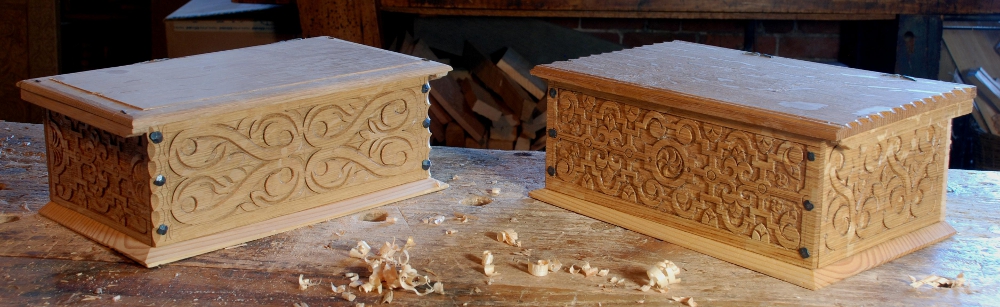
photo of two ornate boxes
photo by Peter Follansbee - used with permission

While working at Plimoth, Peter Follansbee has become an indispensable expert on 17th century New England furniture. He researches and practices furniture making as done by the early settlers. That particular style of woodcarving is very distinctive. These little boxes are small samples of the kind of work applied to furniture panels, chairs, doors, and almost any flat surface that could benefit from adornment. One of the fascinating aspects of the work is that many of the shapes are layed out and executed directly from the tools. One can clearly see how chisels of different sweeps and sizes were used to form many of the curves and swirls. Peter not only works at the Plantation, but teaches classes, publishes a blog of his “joiners notes,” and has recently issued a new DVD “17th Century New England Carving” that is already getting great reviews. To gain a better perspective on this form of carving see one of Peter’s most recent blog entries which shows many examples of this work. Examine the photos very carefully, especially the last one where the tool marks are obvious. You will end up wondering how many chisels Peter must have.
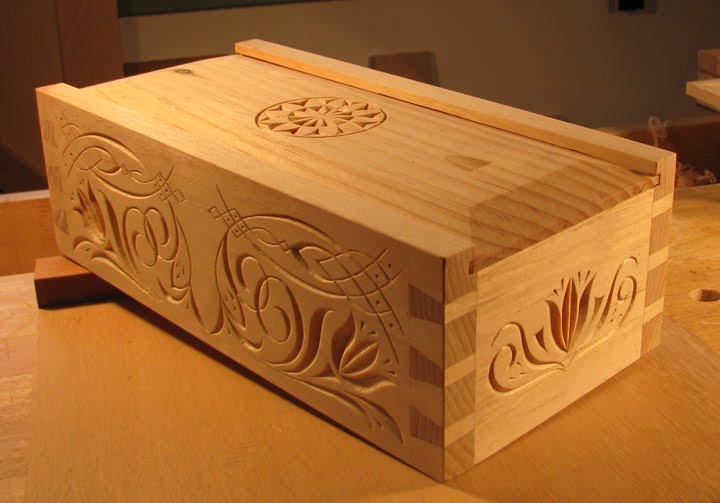
photo of box with carvings on all surfaces
photo by Karu Hultman - used with permission

Staying in two dimensions, and showing another decorated box, we turn to a different sort of carving. Chip carving is done with knives, usually only two. Wayne Barton tells us it is derived from a Swiss style of woodworking, and we most often see it executed as beautiful decorations using heavily repeated patterns. While I’ve seen this form over the years, it was Kari Hultman, The Village Carpenter, who wrote about the technique some time ago. Being a design oriented person, she uses chip carving not as an end to itself, but as a method of adorning other things she creates. The box illustrated at the left uses a traditional geometric pattern on the top and wonderful flowering panels (perhaps Pennsylvania Dutch?) on the other surfaces. For more delight, see what she did to her coffin smoother plane. We can also see that lettercarving is a near cousin of chip carving. Oh, so many beautiful things, such a slippery slope, and so little time.

Before we jump to 3 dimensional objects, let’s look at a couple of architectural carvings.
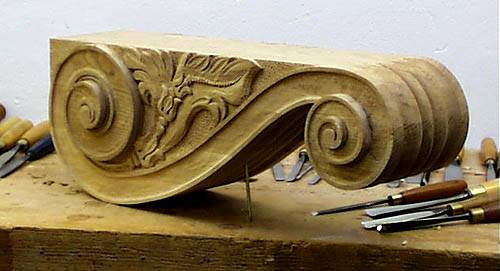
photo of a carved carbel
photo by Chris Pye - used with permission
photo of decorations for stairs
photo by Chris Pye - used with permission

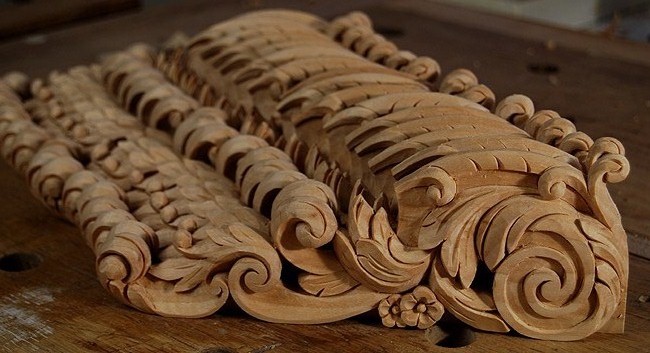
This is a category built upon classic motifs and patterns. We’ve all seen them frequently. Many today are machine made, but the hand carved versions are breathtaking in comparison. Again, these are only a small sample of of the category that includes everything from shell panel decorations, egg and dart mouldings, flame finials, ball and claw feet, and all sorts of things too numerous to mention. Chris Pye’s exquisite acanthus spirals (left) will decorate the ends of stair steps. (Rotate them 180 in your mind.) Imagine knocking out an order for 15 of those this week. Or, maybe making a couple of corbels (right) to hold the roof over the  back door. Chris Pye is a British woodcarver whose scope covers a broad range of carving categories. He teaches classes, (recently in the U.S.), publishes books and DVDs, and maintains a web site where he offers “Slipstones” which are e-books about woodcarving techniques. You might want to subscribe to his newsletter to learn about where and what Chris will be teaching next.

We’re still not at 3 dimensions yet. Next time…

Oh yeah, that beautiful home at the end of the long and winding road. That’s not mine!
Filed Under: Woodcarving

Comment Spam – Policy and Practices

October 30, 2010 by Bob Easton Leave a Comment

I love it!!!

Akismet is a collaborative spam filter available for WordPress blogs. The “collaborative” aspect comes from collecting information about what Al, John, Carly, Janice, and every other Akismet user thinks is spam, and using those marking to filter the stuff from infecting other blogs. I love it! It works very very very well. Catches lots of stuff and flushes it before I need to bother. Akismet silently prevents 100-250 spam comments per day for my blog. It actually holds them in a queue for inspection, but I find it so accurate that I never inspect. I just delete the remnants occasionally.

[Hey, all you Blogger users…. Take note and lobby Blogger to implement real spam filtering instead of those damned CAPTCHAs. CAPTCHAs serve mostly to move the burden away from the provider and to the users, and are a total barrier for many people with disabilities. And don’t argue with me, like one idiot did, that it doesn’t matter because people with disabilities shouldn’t do woodworking.]

However, the best spam filters aren’t very successful for certain targeted marketing that’s based on keywords. Here’s a recent example. It was a comment on my post about Woodworking Appliances. Some robot scanned a bunch of blogs for the word “appliance” and added the following comment, with a link, of course, to their product.

Hi , thanks for the posting. Nice. There are many ways to get rid of hair issues, but first know that bad hair is usually the result of unclean hair and scalp, it is also due to the use of excessive hair product, which usually grab on to your hair making it heavy and dry. Chemical hair products also clog hair pores killing the health of your hair.

BZZZZZZZZZZZZZZT!

There are similar comments that most likely were not done by a robot, but by a person taking the time to search out relevant posts. Had one just like that a couple of days ago on the post talking about other woodworking choices. A small boat builder (sounds friendly enough) posted a message and a link to his single page web site that exists only for selling small boat building lessons.

BZZZZZZZZZZZZZZT!

For that stuff, I use a second WordPress filter called WP-SpamFree. I have mine setup to email me a copy of every comment (which I allow to be posted without moderation). Within that email are three tools: Trash It, Spam It, and Blacklist the sender. Each of them is a one-click tool. Poof!

My policy

If you come here solely to advertise, your comment will get the Spam It treatment, and your IP address will be blacklisted. It takes me less effort to do those two actions than it does you to post the comment in the first place.

Filed Under: About

Boatbuilding and Other Woodworking

October 26, 2010 by Bob Easton 1 Comment

Using small boats is great when weather is good for flip-flops and lift offs, bikini tops and cutoffs (Thanks Travis). One needs to wade into the water a bit to launch, have water drip off the paddle shafts into your lap, and even though the seats in the boats are off the bottom, there’s usually enough water brought aboard that it wicks its way up pant legs that hang over the edge of the seat. It’s no longer that kind of weather, and the water temperature is dropping fast. We could outfit ourselves with cold weather gear, waterproof breeches, boots, and such, but that’s not our style.

Our wardrobe is not full of special purpose costumes for each of our activities. Watching bicyclists in their brightly colored spandex costumes brings chuckles. Good lord! They’re riding along NY country roads, not the Tour de France! The spandex must be helpful in keeping jiggly parts in place as they bump and bounce along the potholes and ruts of our horrendously maintained roads. (Did anyone ever tell you that the tax rates in NY are the highest in the nation? Don’t know what they do with all the money, but it’s not used on roads.) Those bright colors must be so they won’t get shot by the turkey hunters or run down by the Bentley drivers.

""So, without special costumes, our boating season is over … and it’s the time of year to start thinking about building another boat. Well, not exactly. There are lots of boats that I think would be fun to build, but we have a couple of constraints. First, some are too large or heavy for cartopping and there’s no place to park a trailer on our property. Second, the boat shop is getting full and I’m not yet keen about building outside storage for a flotilla of boats. And no, I’m not going to start renting storage space.

Hmmm, maybe I should sell boats to make more room? Nope! That could bring liability problems and New York has way too many lawyers. NY is second only to D.C. with 20.4 lawyers per capita. OK, 20.4 for every 10,000 capitae.

Woodworking includes a huge number of variations. In fact, boatbuilding is a relative back water when compared to many other variants. Maybe the most popular, if the magazine rack at the bookstore, or the number of blogs mean anything is “fine” cabinet and furniture building. Unlike boatbuilding, all of that furniture stuff needs straight boring lines right angles and fancy joinery. No sweeping sheer lines, no wonderfully twisted planks, no rolling bevels, no intriguing acute joins, just straight lines and square corners. I don’t think I’ll ever want to master the dovetail joint. Besides, our house is already full of furniture, and I have no interest in building it for sale, dealing with 20.4 lawyers, etc.

Of course, there are dozens, if not hundreds, of other interesting wood working paths to follow: houses, decks, specailty furnishings (think Shaker), boxes, decorative devices of all sorts, and more! Kari Hultman, “the Village Carpenter,” is a one woman show about the variety of woodworking one can enjoy.

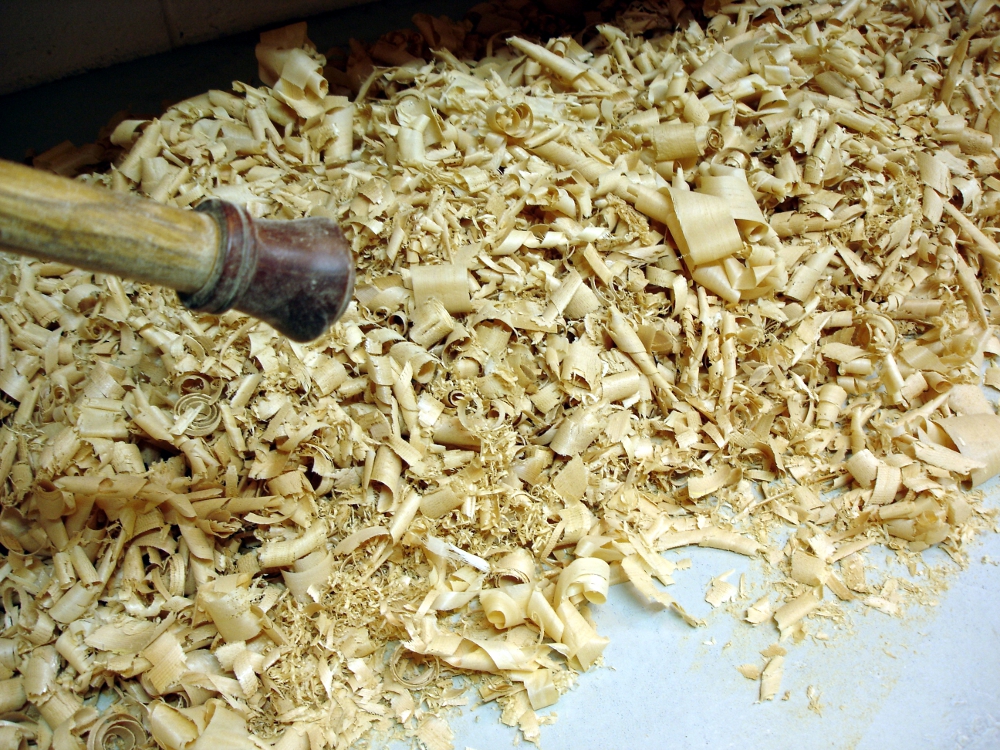
Wood turning? Maybe soon. That partially finished treadle lathe only needs this ole crank to make some cranks and finish fitting it out.

Wood carving? Getting warmer (as in the Hot & Cold children’s hunting game). More in the next posting.

Filed Under: Woodworking

  • « Go to Previous Page
  • Page 1
  • Interim pages omitted …
  • Page 67
  • Page 68
  • Page 69
  • Page 70
  • Page 71
  • Interim pages omitted …
  • Page 129
  • Go to Next Page »

Primary Sidebar

Footer

Recent Posts

  • Sign Your Work!
  • New Frame Saw / Scroll Saw
  • Lamppost Sign
  • Goodbye PayPal – Goodbye Bob’s eBooks
  • Anarchist’s Workbench is Done

Categories

  • About
  • Artwork
  • Boatbuilding
  • Boating
  • bowl carving
  • Boxmaking
  • Clocks
  • Drawings
  • eBook
  • etude
  • Eva Too
  • Eva Won
  • Fiddlehead
  • Fiddlehead model
  • Flying
  • frame saw
  • gilding
  • green woodworking
  • Grinling Gibbons
  • Guns
  • Hand tools
  • Humor
  • kerfing plane
  • Lettercarving
  • Mill Creek 13
  • Model building
  • Power tools
  • Rant
  • resawing
  • scroll saw
  • Shopmade
  • sign painting
  • Stonework
  • Swimming
  • Technology
  • The Wall
  • treadle lathe
  • Uncategorized
  • VSD
  • Woodcarving
  • Woodturning
  • Woodworking
  • workbench

Other stuff

  • About
  • Contact
  • Privacy Policy

Copyright ©2024 · Bob Easton · All Rights Reserved