• Skip to primary navigation
  • Skip to main content
  • Skip to primary sidebar
  • Skip to footer

Bob Easton

Chocolate powered woodworking

  • Home
  • Grinling Gibbons Tour

Hatchet, Adze, Drawknife

October 13, 2019 by Bob Easton 4 Comments

Andrei showed us some skilled hatchet carving in the previous post, and in that post I also mumbled something about my own hatchet.

It is all David Fisher‘s fault.  I’ve acquired a few “green woodworking” tools and am trying to learn how to use them.  David’s bowls are spectacular, and it is this one that led me down the path.  Of course, there was an initial obstacle.  “The Great Adze Shortage of ’15” seems to be lingering.  Inventory from the well known adze makers is still non-existent anywhere.  Did they all go out of business, or is demand so high that traditional retailers simply can’t keep them in stock?  Dunno.  I found an answer (more on that shortly), and while waiting for the adze to arrive I turned my attention to refurbishing an old hatchet.

My “Boy Scout” hatchet*

It is a very simple, utilitarian tool.  I don’t remember when or where I acquired it.  I do remember replacing a cracked handle some years ago.  After learning a wee bit about bowl carving work with hatchet, adze and drawknife, I realized the grind on this old hatchet was completely wrong.  The grind was as it came from some store long ago, a blunt grind that is extremely sturdy and entirely appropriate for rough bushwhacking, definitely NOT for carving.

photo of my re-ground hatchetJob #1 then became regrinding the hatchet for carving.  Using the “scary sharp” sandpaper method, I took it from the blunt near-40° to something closer to 30°.  The result is much much much better.  More bite, fewer glancing blows.  It’s still not the perfect flat grind that I want, but I’ll get it there.

Job #2, and not absolutely necessary, …but since I was still waiting for an adze to arrive… was a cover/sheath for the hatchet.  Of course, it is wood, and of course it has some carving involved.  Inspired yet again by David Fisher, the result was fun to make.

photo of hatchet sheath - showing 3 parts
photo of hatchet sheath - front
photo of hatchet sheath - back

*So… Is it “hatchet” or “axe?”  Some answers to that question say that usage distinguishes the term.  Use one handed: it’s a hatchet.  Use two-handed: it’s an axe.  I use this tool one-handed.

An adze and drawknife

I found my answer to the great adze shortage on Etsy.  Search Etsy for adze and you’ll find several blacksmiths making adze’s, axes, drawknives and other green woodworking tools.  After some additional research, I settled on making an order to Sergey Ivin from KharkivForge.  Yes, it took a good while, but Sergey states on his Etsy store page an estimated fulfillment time.  Add about 10 days for transit from Ukraine to the US.

photo of adze and drawknife from Sergey IvinBoth tools arrived ready to use, sharpened to a level that easily passes the arm-hair shaving test.  Each also arrived with very nicely made leather blade sheaths and the adze included a leather carry strap in case you want to take it along wherever you wander.

Clearly, I have no prior experience with these sorts of tools and don’t yet know what distinguishes one from another in terms of the best steel, the best handle material, the best working geometry, etc.  Yet, after a few hours of using them, I find both tools very effective at doing what is expected, and very comfortable in handling.  Sergey at KharkivForge delivered good tools and I’ll certainly consider him when I want more.

Now, to make something with them…


Filed Under: Woodcarving

Hatchets – Andrei’s and mine

September 28, 2019 by Bob Easton 4 Comments

A sweet little bowl from David Fisher caught my attention a few months back. That bowl inspired me to find my old “Boy Scout hatchet,” refurbish it, find an adze, and set out on a bit of green woodworking.  But first, let’s look at a different kind of green woodworking half way around the globe.

Woodcarver Andrei on Kizhi Island, Russia

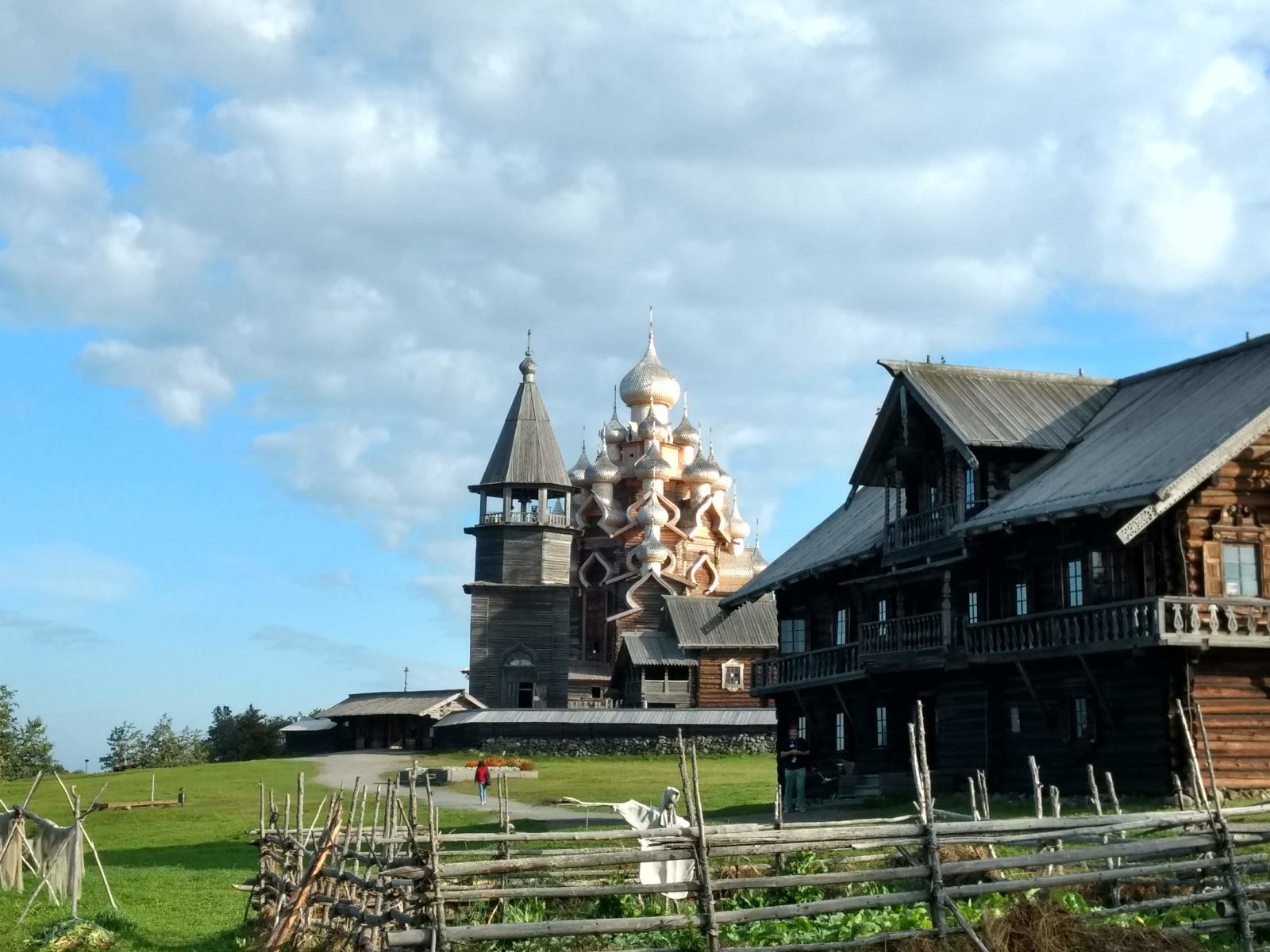
photo of church of transformation on Kizhi Island, Russia

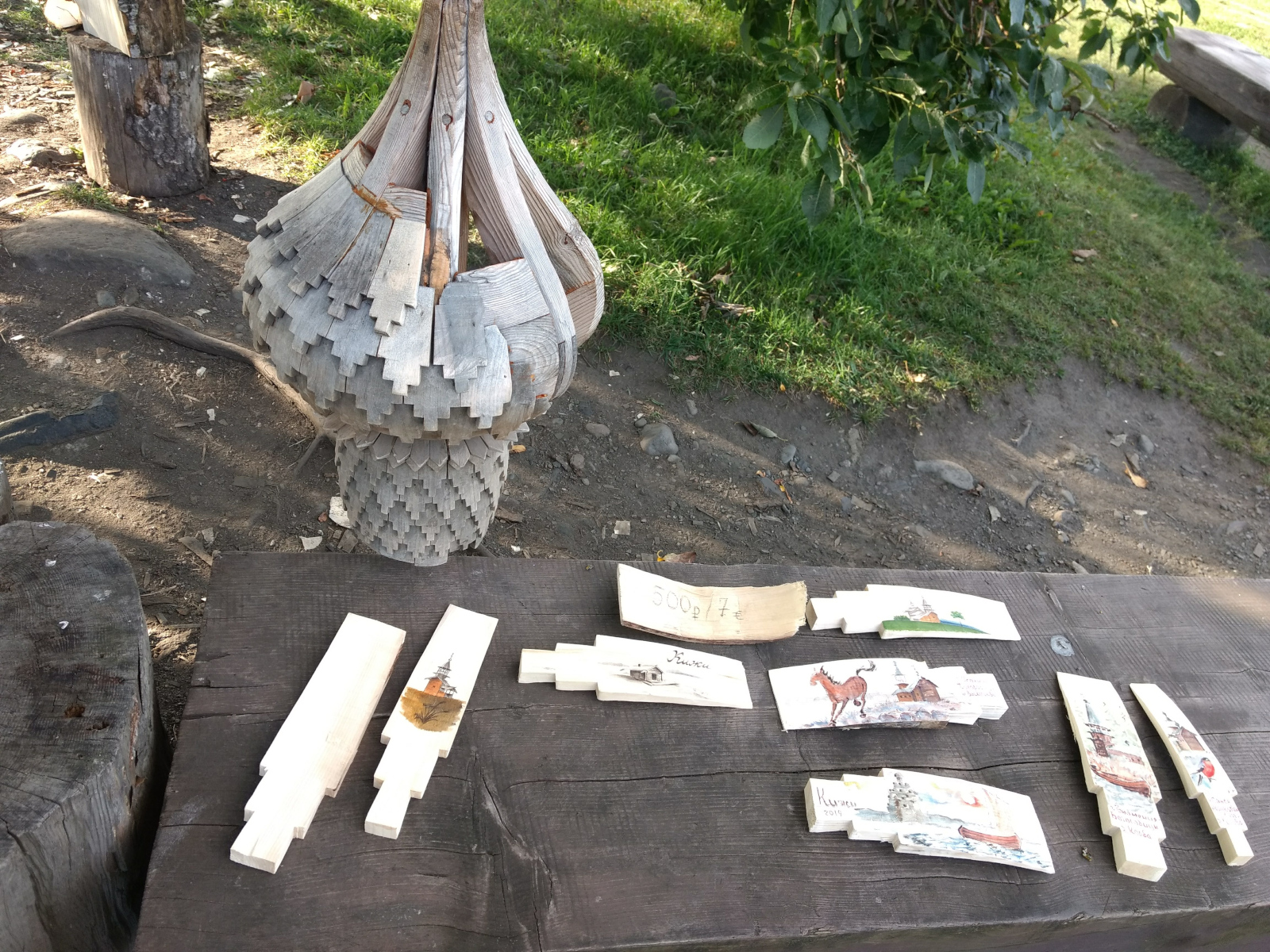
Kizhi Island, a smallish island in Lake Onega in Russia, is now a museum.  The island is home to dozens of wooden buildings, many of them churches, the largest of which is the Church of the Transfiguration, which supports 22 onion-shaped wooden domes.  It would be easy to fill a long blog post with pictures and stories of those churches, but I will focus this post on the wooden domes and the aspen wood shingles* that cover them.  In particular, we will watch Andrei demonstrate how those shingles are created.

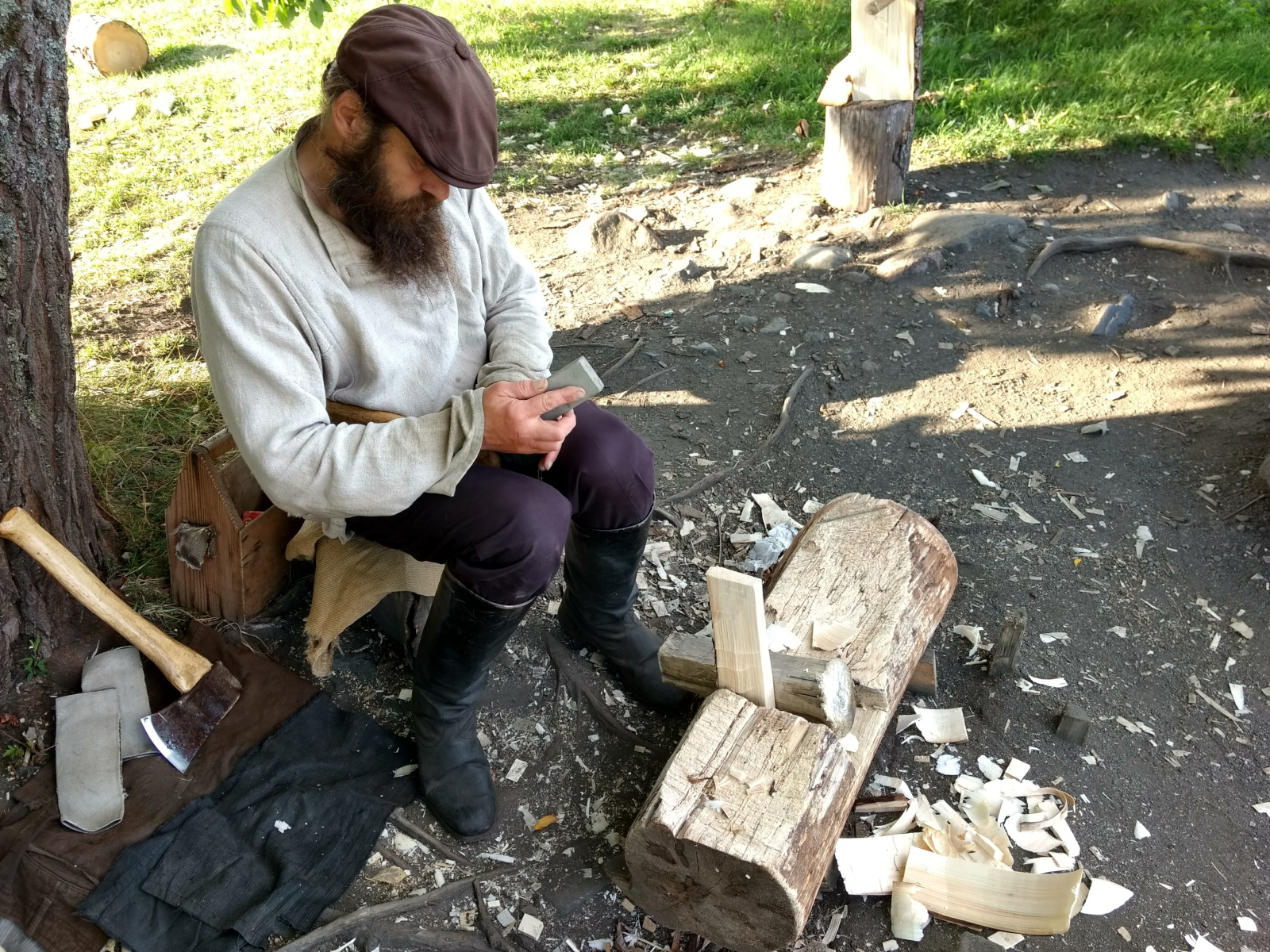
Our visit to Kizhi was early in the morning and I found Andrei just getting ready for his work. He was sharpening his two hatchets. He used what appears to be an Arkansas stone, and no stropping.

Using only hand gestures (I have no Russian language skills), I asked if I could test the sharpness of one of his hatchets.  His answer was the universal back and forth wagging of a finger.

photo of typical roof shingles for Kizhi Island churches
photo of Andrei sharpening his hatchets
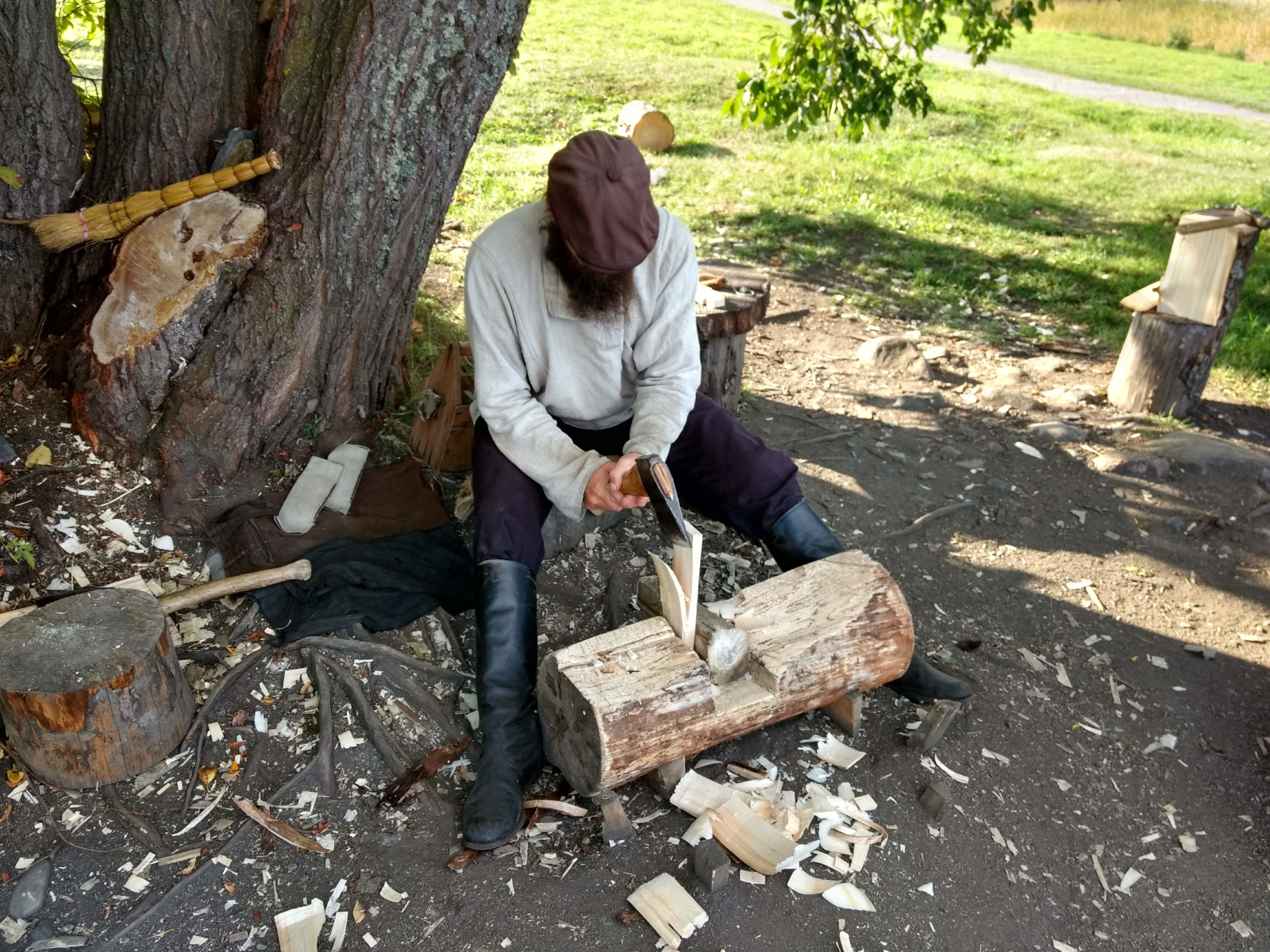
photo of Andrei carving a shingle

Andrei then went about making a shingle, which I captured in two videos.  First, he splits a blank from an aspen log he had nearby.  I found it interesting that his splitting wedge appears to be yet another hatchet blade with the handle loop broken off.  His log is also just the right length for a shingle, and splits cleanly.

Then, in a mere 2 minutes, Andrei shaped the blank into a shingle.  I was interested not only by the shape of the log block he uses as a “workbench,” but how efficient each of his actions are.  Note how after cutting one notch, he walks the blade across the blank to the other edge to place a notch there.  No rulers, no squares, no pencils, just thousands of previous “muscle memory” actions.

*Why aspen?  One article about Kizhi cites:

Aspen is flexible, strong and doesn’t burn easily. … Aspen shingles weather to a beautiful silvery-grey and are resistant to rotting and warping.

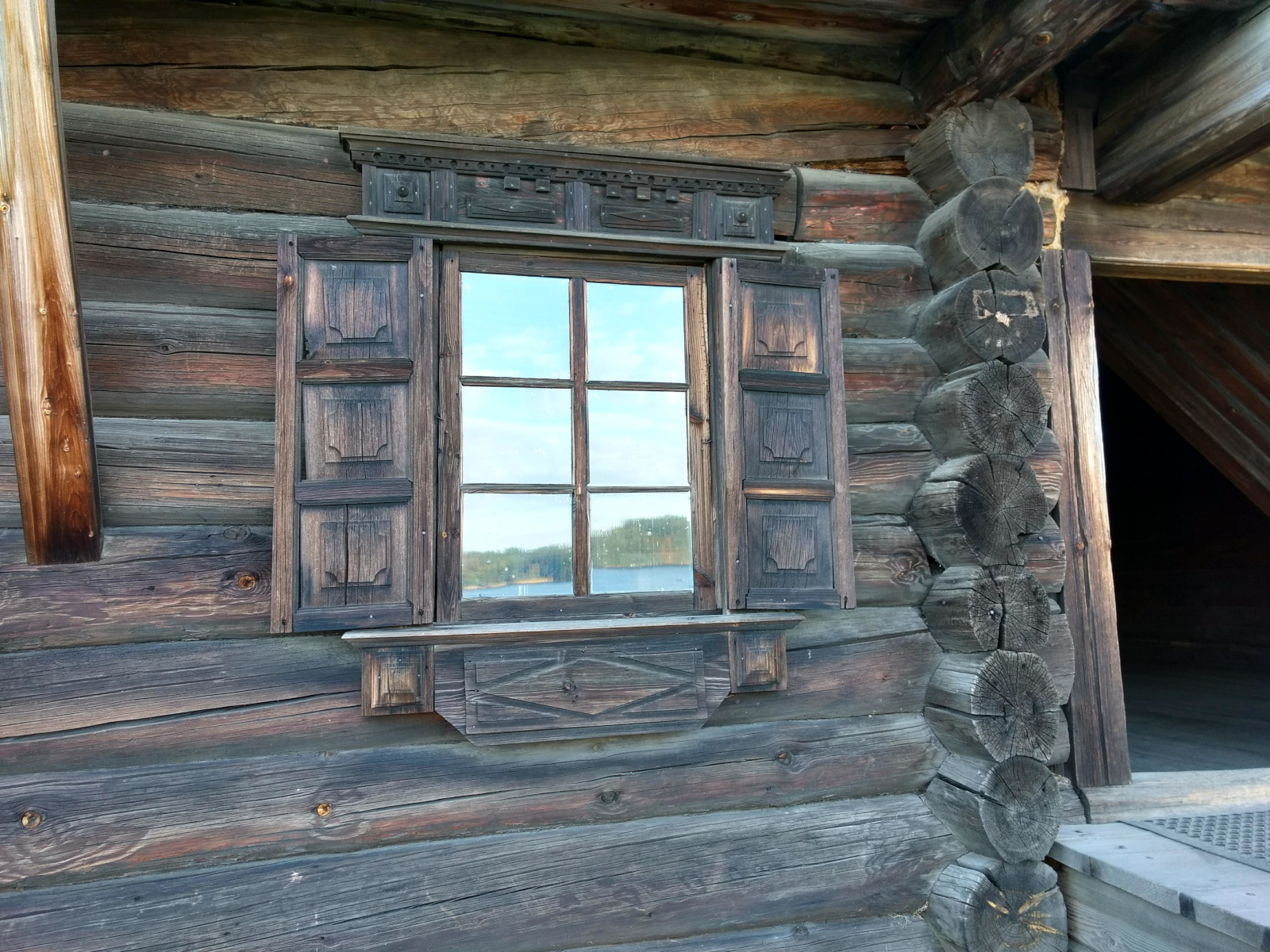
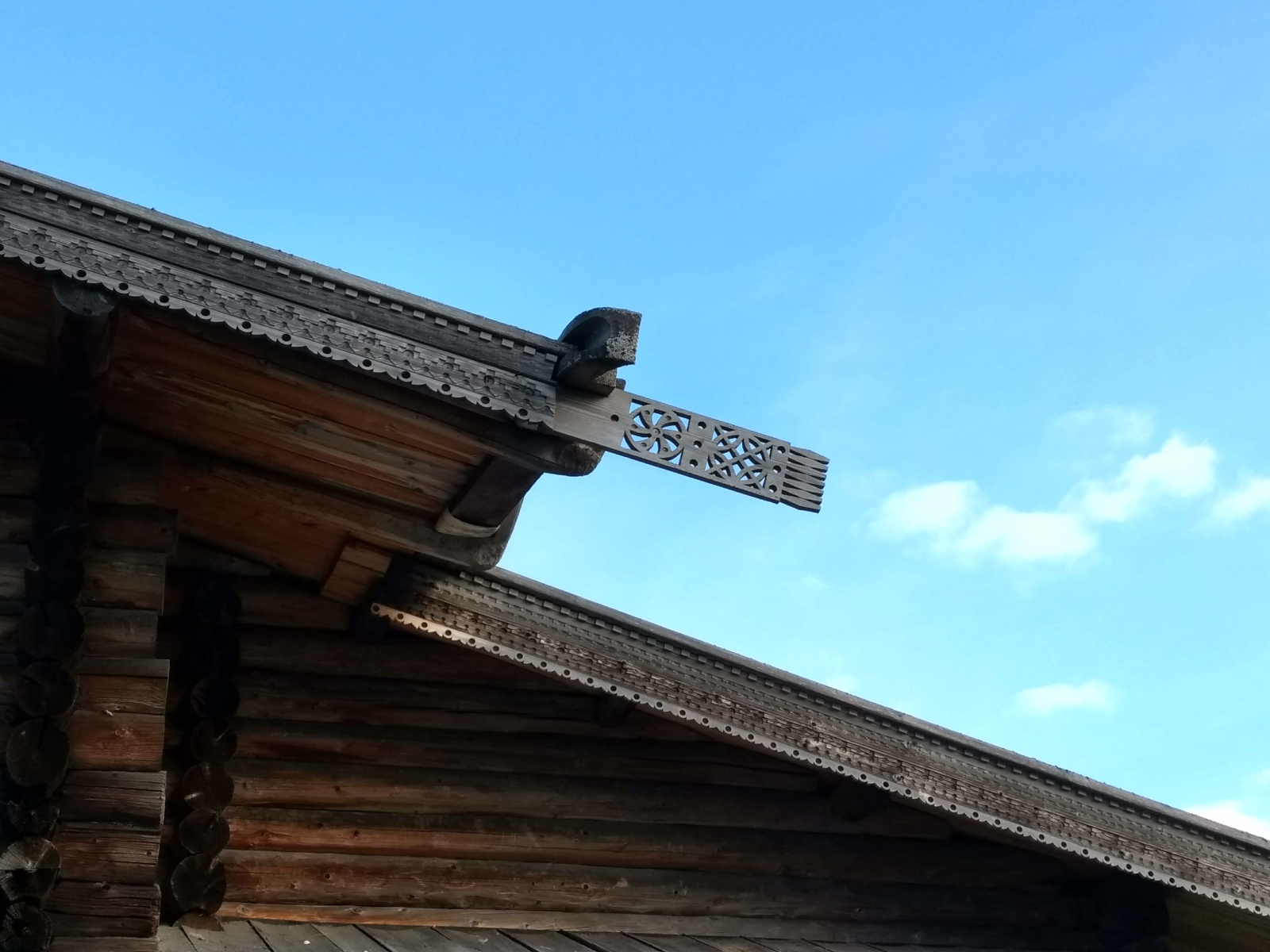
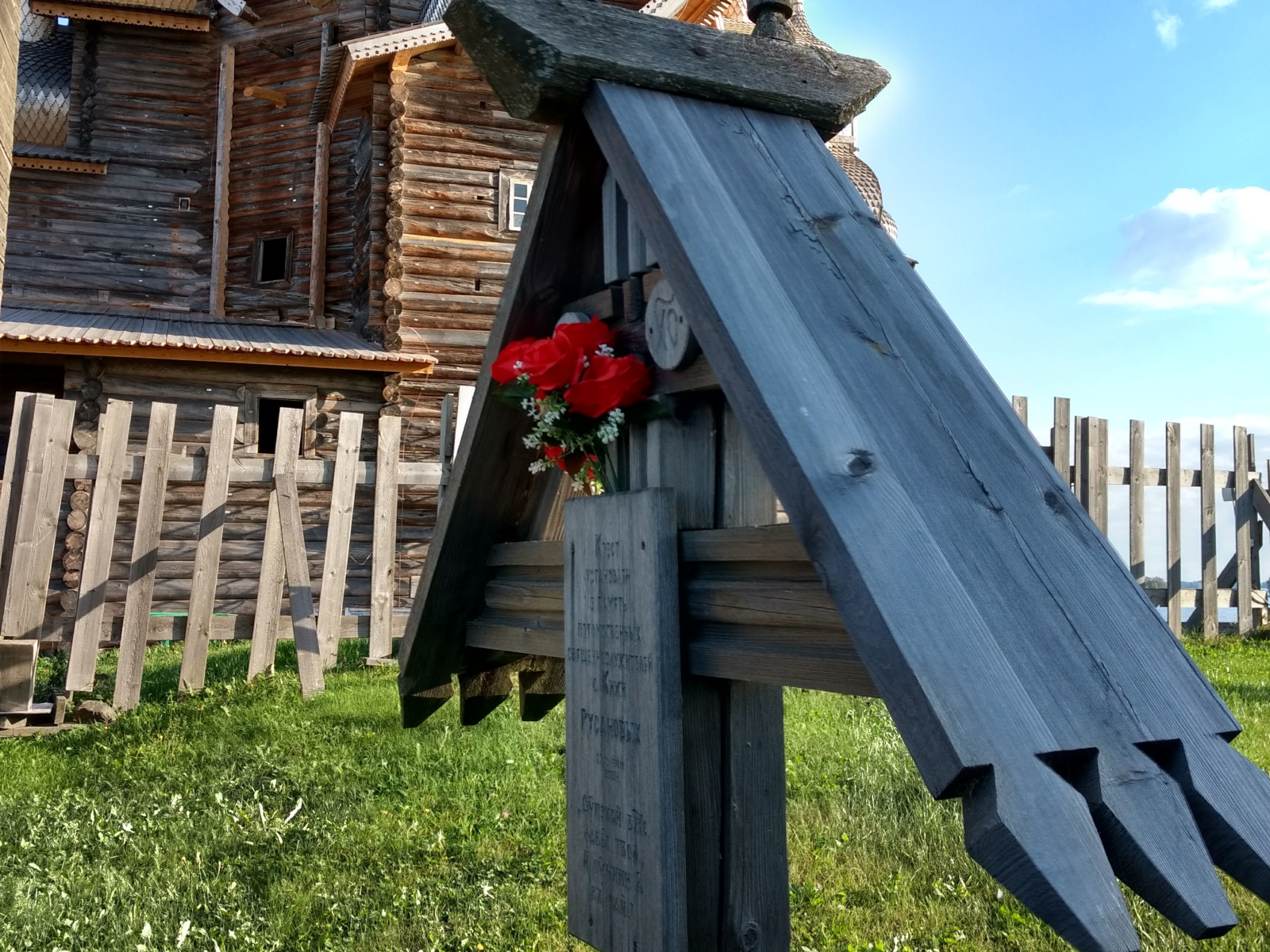
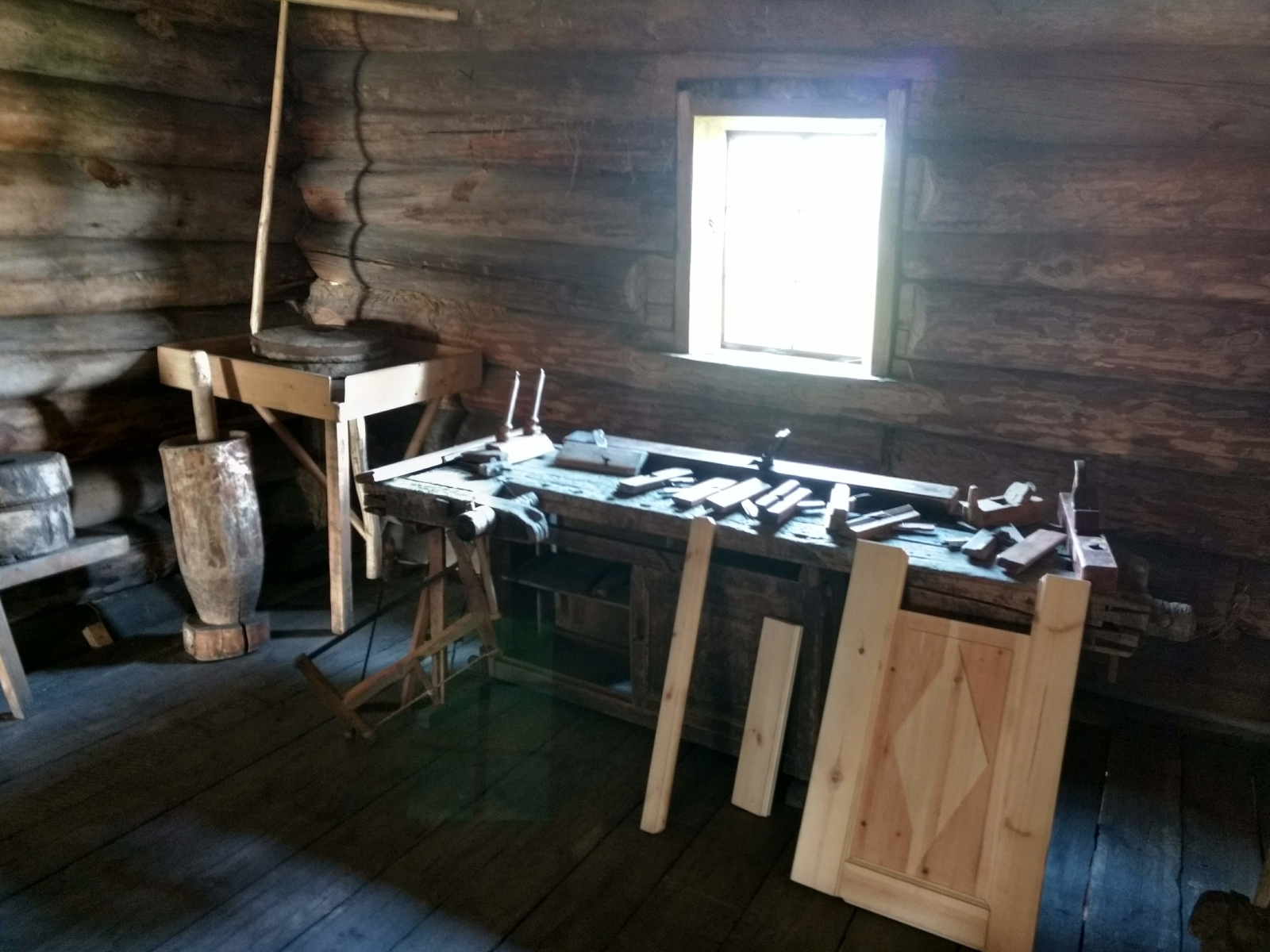
Kizhi Island offers woodworkers and carvers who enjoy seeing how old log buildings are constructed, fretwork ornamentation, ironwork and various household and workshop items, more than one has time to see. (slideshow hint: For more detail, right-click on an image, then select open in a new tab.)

photo of several Kizhi buildings
photo of log building facade
photo of fretwork on a log building
photo of a small church
photo - detail of dome on a small church
photo of grave marker fretwork
photo of a woodworking bench
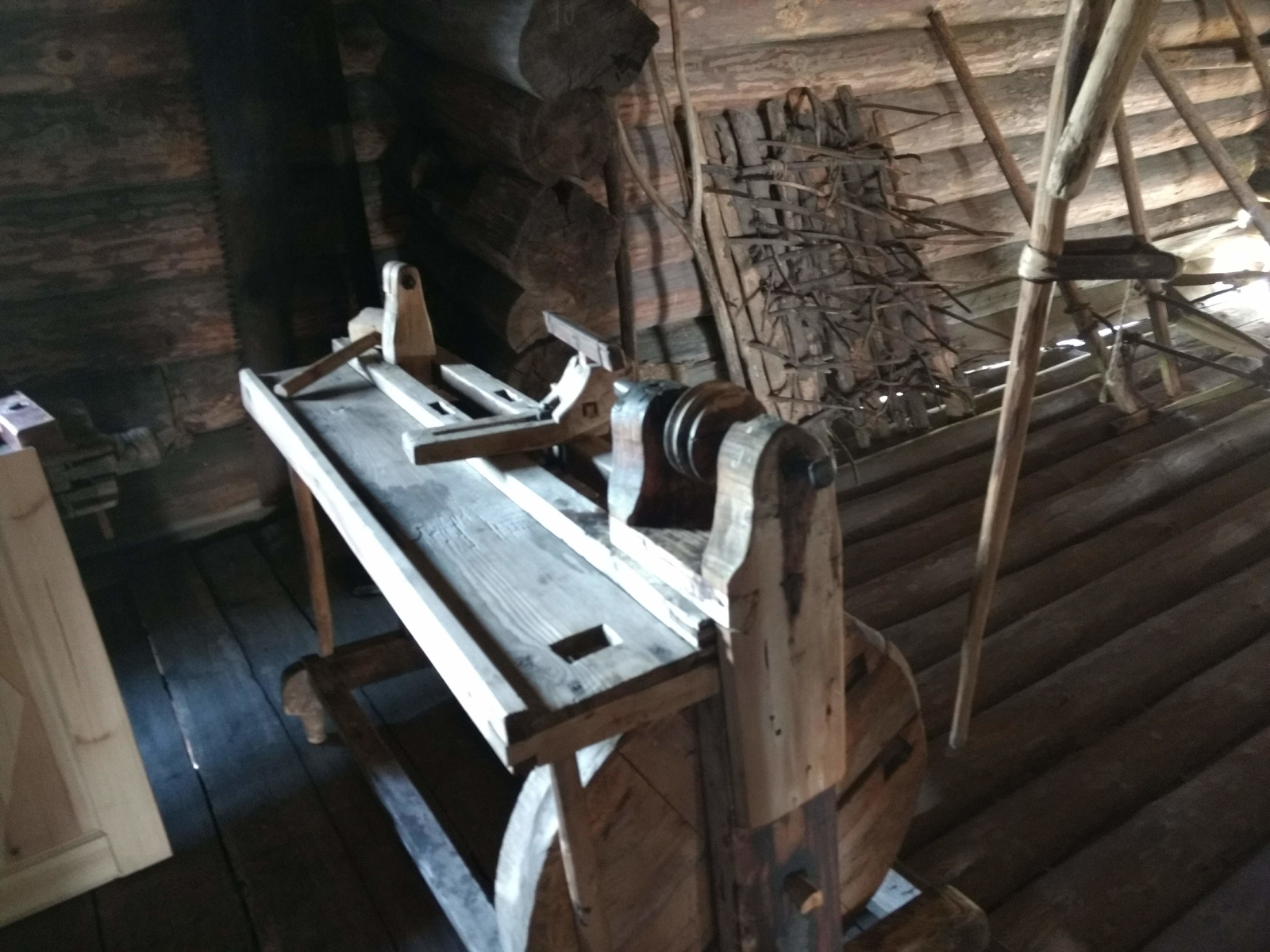
photo of a treadle lathe
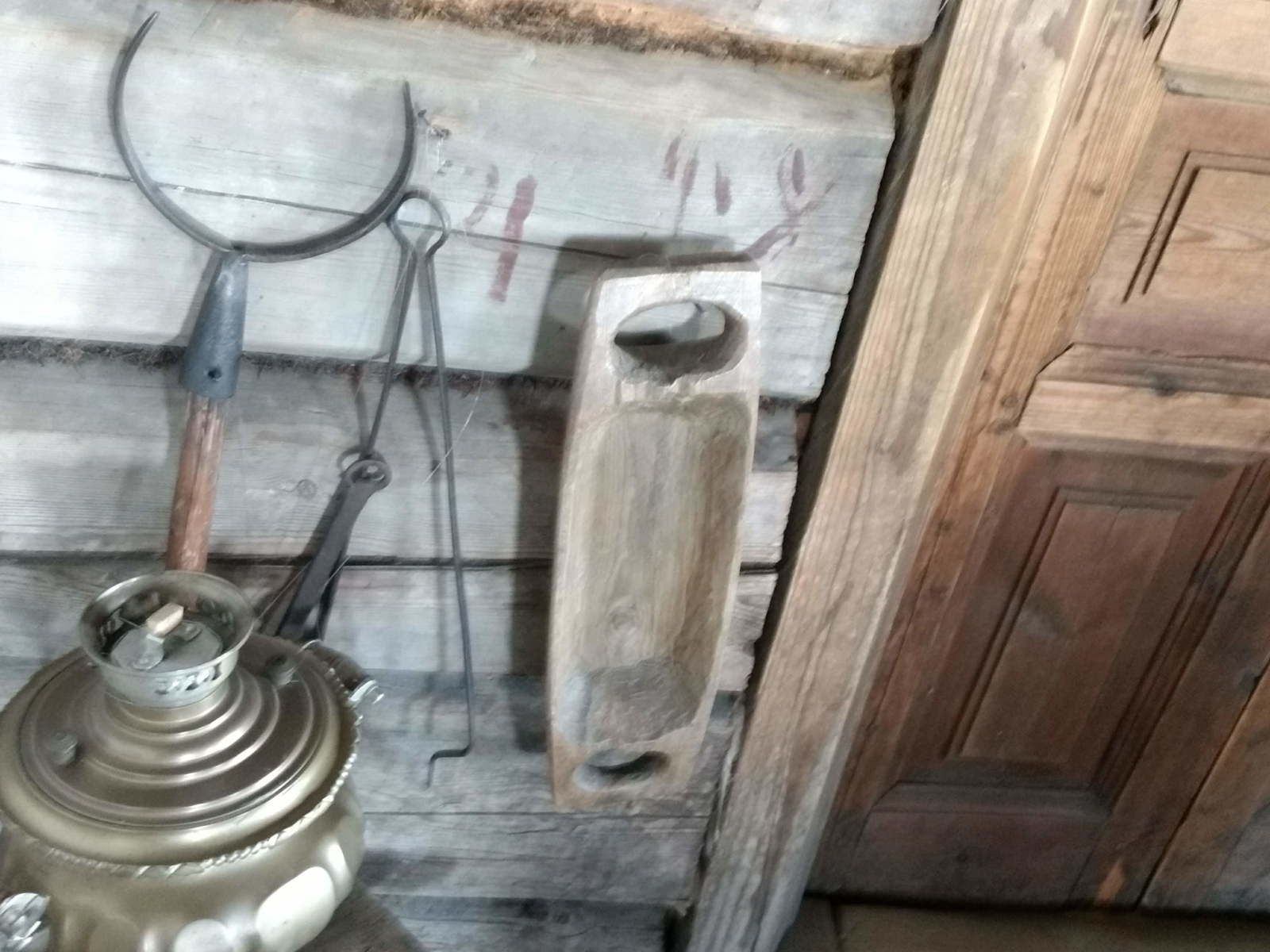
photo of carved wooden bowl
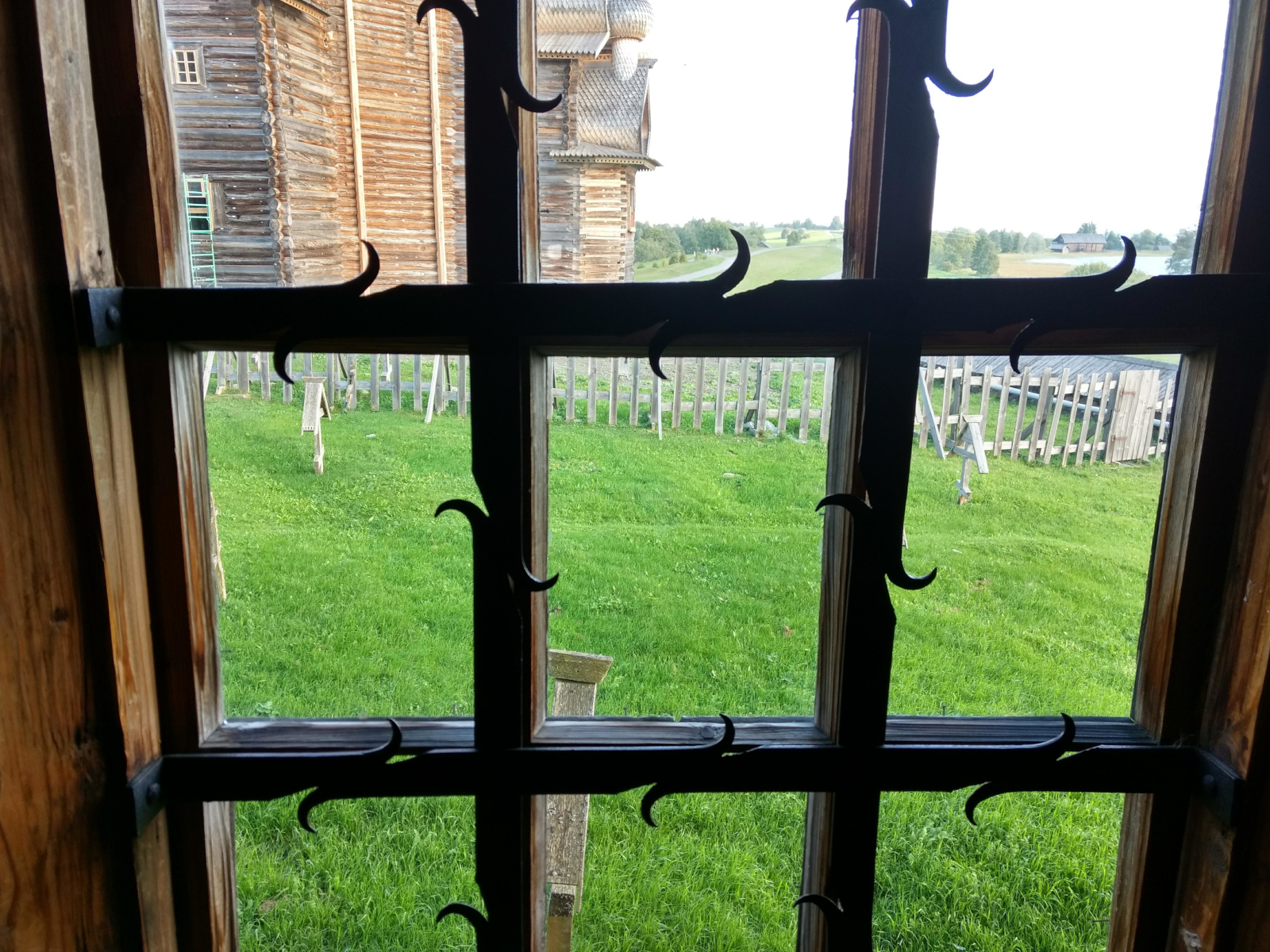
photo of protective ironwork on a church window

My own hatchet

The primary difference between a store bought utility hatchet and one used for woodcarving is how the blade is honed.  Andrei’s hatchets are very nicely honed for carving.  Next time, a look at my refurbished hatchet.

Filed Under: green woodworking, Woodcarving

Other People’s Lathes – Simon Jack

November 26, 2018 by Bob Easton Leave a Comment

Some time ago, I asked all the purchasers of my Treadle Lathe ebook if they would like to show us the lathes they have built. A few responded with pictures and information. This is the fourth in a series of those responses. (1st one here, 2nd one here, 3rd one here )

I ~think~ Simon Jack lives somewhere way up in the north of Scotland.

As you will see Simon, like most builders, applies ingenuity to what he builds … and he apparently has an abundance of old auto parts to draw from. 🙂  He says:

” I’ve eventually managed to build a treadle lathe which works quite well. It’s not the prettiest thing in the world, there’s signs of emergency surgery here and there, but I’ll re-do the headstock etc etc next time i’m home. I added 30 kilos of lead diving weights to the flywheel to increase the mass, and a Ford Transit wheel disc to give the spindle added momentum. The V belt tensioner came off a 1980 model Ford Escort. All that’s needed now is a reasonably priced elephant so I can shift the thing around…. ”

In another email exchange, this time about weighted flywheels, Simon replies:

“I’m very much a novice at wood turning but then again everyone starts from square one, and learning the hard way is usually the best way.   I downloaded a lot of YouTube videos on this subject and I was left with the impression that the heavier the flywheel the better. One or two advocated an extra flywheel on the spindle (8 kilos in my case) so I tried that, and it was a definite improvement; but I still need get it properly balanced. I ended up changing this and that as I went along. I used a bicycle pedal crank cut down and re-welded to 2.5 inches between centres, i also tried 3.5″ tried 4.0″. I used oak for the head stock and the co-rod etc..”

Simon sent these photos for our enjoyment…

Simon Jack's treadle lathe

I very much enjoy seeing how other people have built their own versions of lathes. It is interesting how we adapt to our own tastes, needs, and available materials. Every one of these lathes shows ingenuity in solving some of the mundane foibles of home-built machines, and gives me ideas of how to make some of my own improvements.

THANKS very much for showing us your work Ty, Dave, Joseph and Simon. This is the last of the lathes people told me about. If you have a lathe you would like others to see, please let me know and I’ll be delighted to show your work too.

Simon and all the rest of you, are very welcome to add additional information or discussion with the Comments form below.

Filed Under: treadle lathe

  • « Go to Previous Page
  • Page 1
  • Interim pages omitted …
  • Page 8
  • Page 9
  • Page 10
  • Page 11
  • Page 12
  • Interim pages omitted …
  • Page 129
  • Go to Next Page »

Primary Sidebar

Footer

Recent Posts

  • Sign Your Work!
  • New Frame Saw / Scroll Saw
  • Lamppost Sign
  • Goodbye PayPal – Goodbye Bob’s eBooks
  • Anarchist’s Workbench is Done

Categories

  • About
  • Artwork
  • Boatbuilding
  • Boating
  • bowl carving
  • Boxmaking
  • Clocks
  • Drawings
  • eBook
  • etude
  • Eva Too
  • Eva Won
  • Fiddlehead
  • Fiddlehead model
  • Flying
  • frame saw
  • gilding
  • green woodworking
  • Grinling Gibbons
  • Guns
  • Hand tools
  • Humor
  • kerfing plane
  • Lettercarving
  • Mill Creek 13
  • Model building
  • Power tools
  • Rant
  • resawing
  • scroll saw
  • Shopmade
  • sign painting
  • Stonework
  • Swimming
  • Technology
  • The Wall
  • treadle lathe
  • Uncategorized
  • VSD
  • Woodcarving
  • Woodturning
  • Woodworking
  • workbench

Other stuff

  • About
  • Contact
  • Privacy Policy

Copyright ©2024 · Bob Easton · All Rights Reserved