• Skip to primary navigation
  • Skip to main content
  • Skip to primary sidebar
  • Skip to footer

Bob Easton

Chocolate powered woodworking

  • Home
  • Grinling Gibbons Tour

Rolling Along – Bottom Bevels

February 3, 2009 by Bob Easton 4 Comments

It was moderately warmer in the shop yesterday, making for a good day to work on the bottom bevels. We left off with a big bottom board attached to the stems, the mid-frame, and the bulkheads. It stands proud of all of those and needs to have its edges beveled so that the planks can fit neatly. The bottom bevel is a continuously “rolling” bevel. Near the stems it is very steep, something near 60 degrees. At the mid-frame, the bevel is very shallow, near 25 degrees. There are several simple challenges for making this bevel, each easily accomplished.
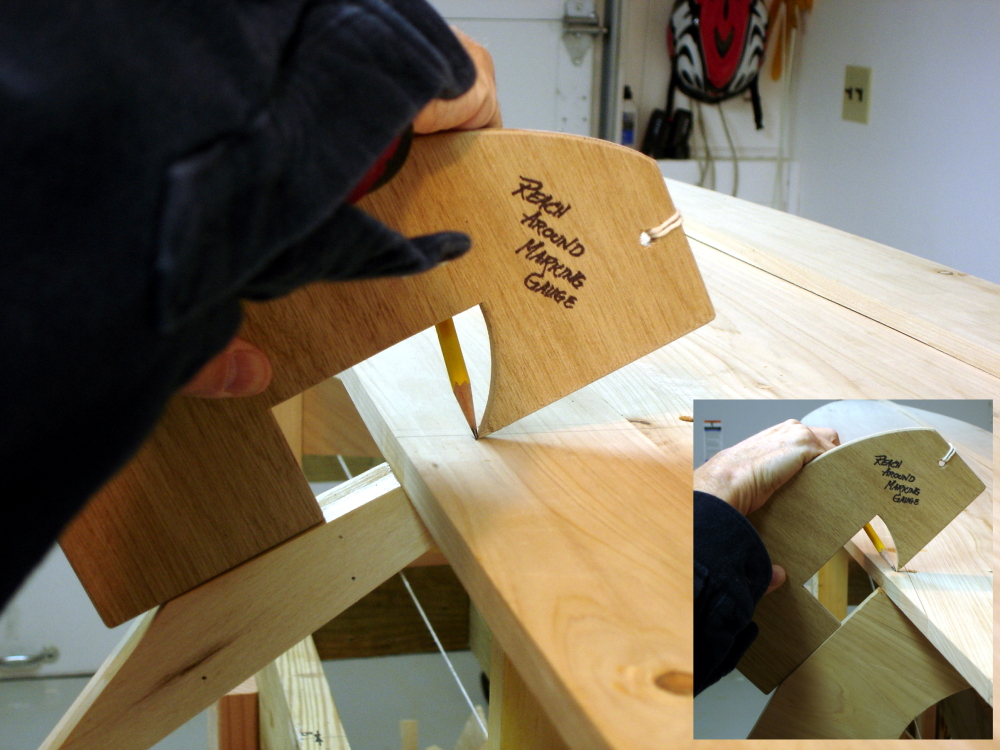
reach around marking gaugeFirst, we need to know the boundaries of the bevel. One part is easy, the existing top edge. The other a bit more difficult. Find the point where the straight line extension of a frame, bulkhead, or stem intersects the bottom surface. The overhanging board prevents the simple use of a straightedge. The trick is “Greg’s (pat. pending) Reach Around Marking Gauge.” Not only does the gauge reach around the edge, I reached around the gauge when making the picture, to make it easier for you to see how the gauge is used.
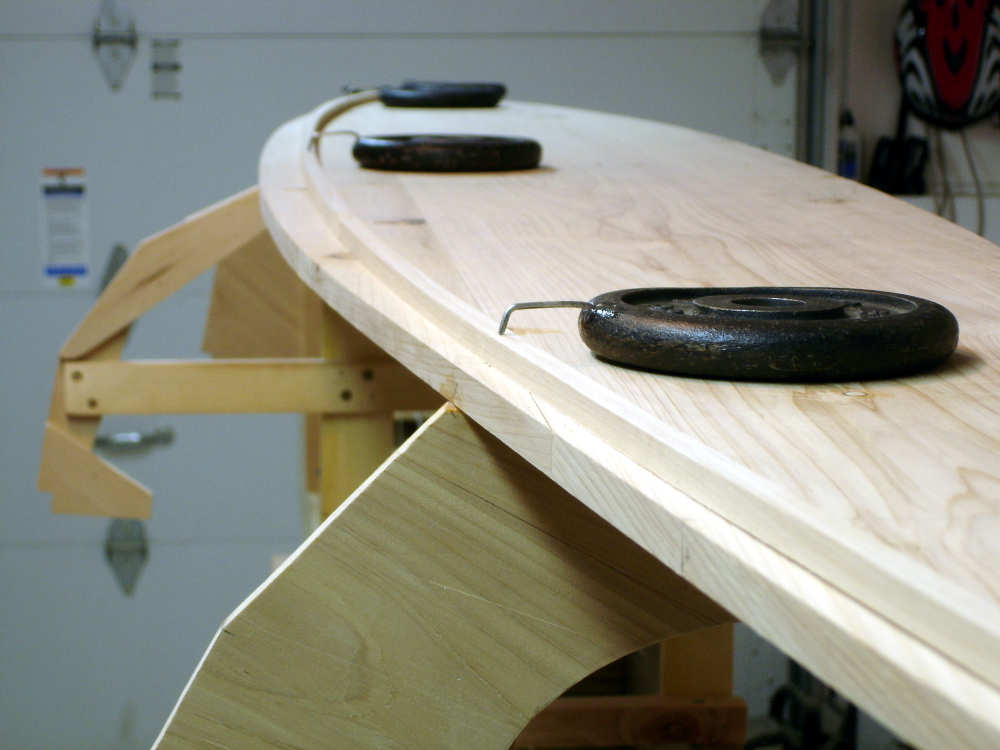
batten and lofting whalesConnecting only a few marks into a smooth curve is the next step. I have a number of flexible battens that curve easily. They are about 3/8 inch square and 15 feet long. Something is needed to hold the battens to the marks while marking the line. There are nifty tools for this task called drafting ducks, spline weights, or lofting whales. They are basically hunks of metal with a metal rod extended from one end. They are  traditionally shaped like ducks or whales, leading to the various names. Find a picture at the WoodenBoat Store. These little goodies are available for a mere $22 to $40 each, and a serious boat builder might need a couple dozen of the things. Being a stingy ole galoot, I found that 3 pound barbell plates with a piece of metal rod drilled and epoxied into them could be made for about $4 each. Not as pretty, but certainly functional. They held the battens still enough to make a fair line.
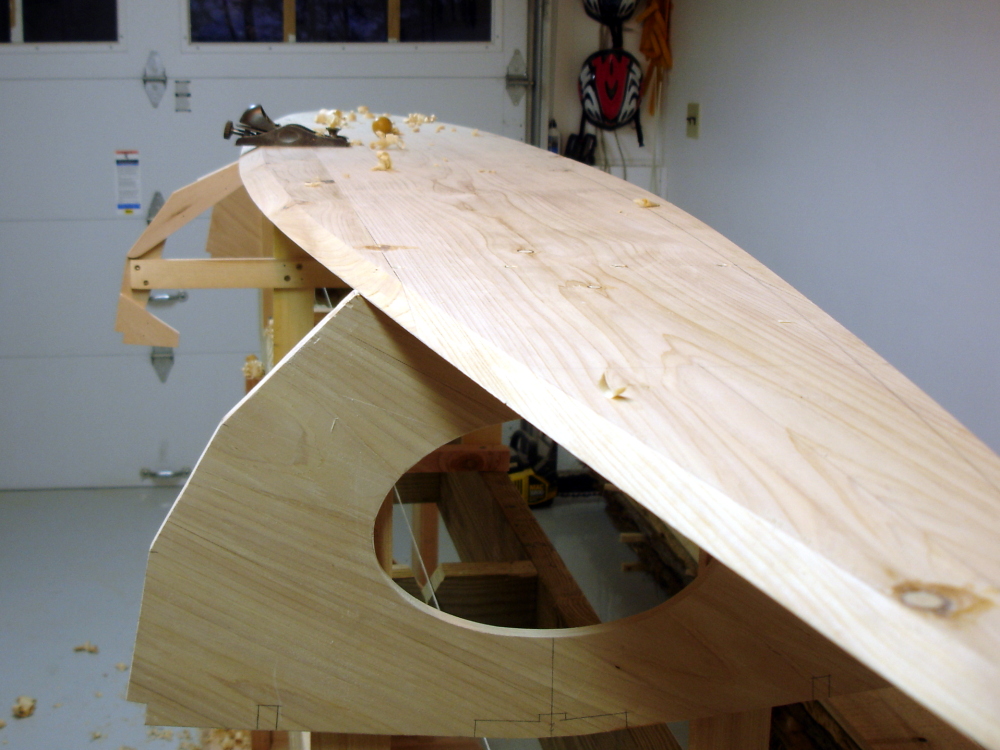
rolling bottom bevelWith the lines struck, the rest is simple. Use the ancient Stanley low-angle block plane to remove all the material between the board’s edge and the line, rolling the plane as the angle changes. Keeping the surface of the bevel flat is a bit of fussiness, not difficult, but essential to ensuring a good watertight join. Yes, it felt good to be shaping wood again!
Filed Under: Boatbuilding, Eva Won, Fiddlehead

Boatbuilding or Artwork?

January 26, 2009 by Bob Easton 1 Comment

The boat builders up in Maine declare winter as building time. They either have better heated shops than mine, or own more layers of clothes. The past couple of weeks have been colder than in recent years, leaving the boat to sit lonely in the cold shop.

In the meantime, I’ve been doing a little bit of artwork.  A brief encounter with a group of people in an online workshop reminded me of an experience at the Wooden Boat School last summer. The reminder came as people in the workshop introduced themselves, one being from Maine’s Mt. Desert Island, home of Bar Harbor.

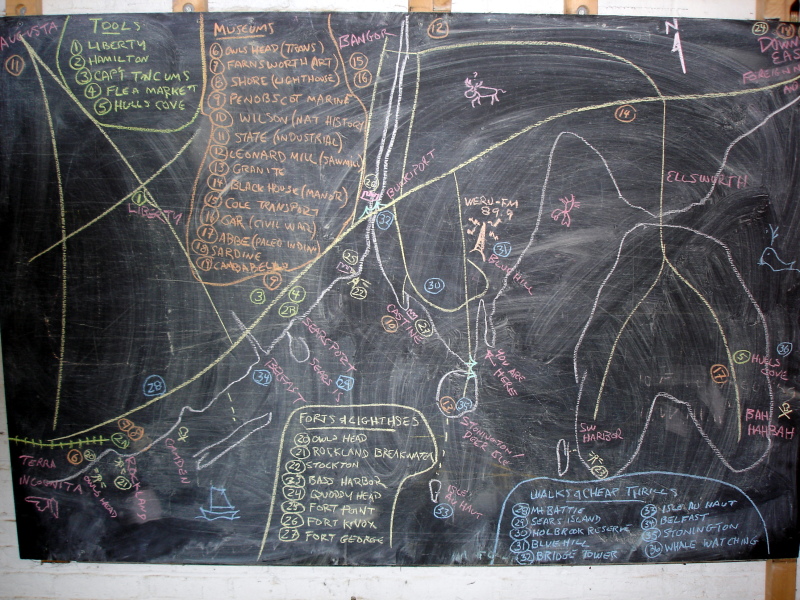
Greg's weekend mapOn a Friday morning Greg Rössell, our Wooden Boat School instructor, produced a hand drawn map of the area’s weekend attractions. (Click on the image to the right for a larger view.)  He had color coded the map with museums, old tool sellers, forts and lighthouses, walks and cheap thrills, etc.

Two places on the map were marked with skull and crossbones markings. One was at “Bah Hahbah,” and the other at Camden. Both were warnings about the “artsy fudge and scented candle crowds.”

Salty ole boat builders apparently have low tolerance for art, at least the touristy kind.  Here, I appreciate both activities … but don’t have any kitsch or scented candles.

Filed Under: Artwork, Boatbuilding

hand*book journal co. – BETTER Than Moleskines

January 25, 2009 by Bob Easton 4 Comments

The people who market the current line of Moleskine products have done a fabulous job. They’ve turned a rather mediocre product into something with a cult following. The hype they publish about VanGogh, Picasso, Hemmingway and Chatwin using their notebooks is pure mythology. Those people used notebooks of a bygone era, notebooks that were published by a firm that failed and went out of business long ago. Today’s Moleskines are similar in name only. Whoever bought the brand name bought the legend, and the myth too. Fabulous marketing!

I have a couple of Moleskines and use them for sketching, but nothing more serious. The standard notebooks, the ones that have a manila or yellowish paper are OK for pencils and some pens. Some of the pens I favor don’t work well with them, and as others in a workshop have noted, they’re really not good at all for water media. Most water media makes the pages buckle too much and gets so absorbed that the colors turn out as pale pastel images of what they should be. I like the Moleskine watercolor books better. They have WHITE paper in them and it works well for most of the media I use.

…and as we have heard recently, new Moleskine notebooks from China have a tint and paper quality that many people don’t like.

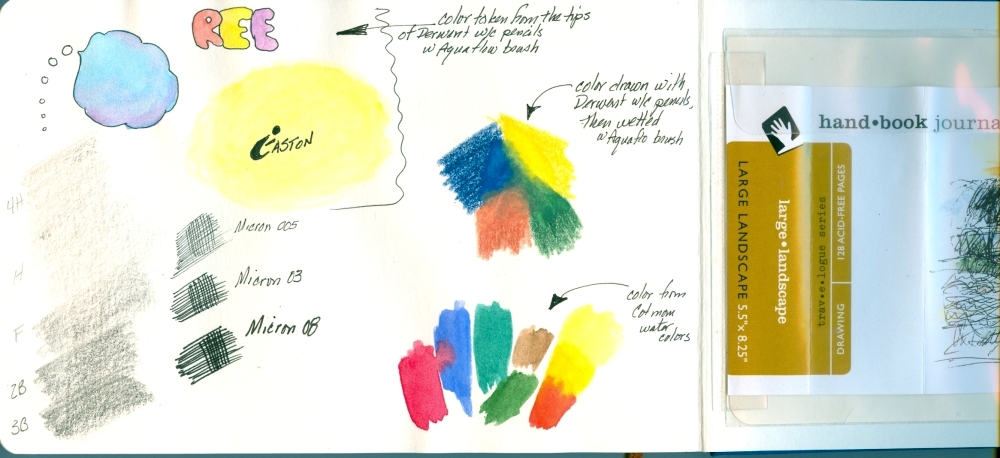
hand-bookThere is a BETTER Alternative. At least in my opinion. A new firm, based in Kansas City Mo., has popped up recently. Their notebooks, “hand*book journal co.” have many features similar to Moleskine notebooks, but far superior paper. I find the paper for more suitable for the media I use: pencil, pen and ink, colored pencils with and without water, and watercolor. (I haven’t tried them with acrylics, gauche, or other media.) First, the paper is not as yellow. It is called “buff,” what I would label as ivory. It has good tooth for pencils, but not so much as to be difficult with pens. It accepts light water application and, best of all, water based media stays rich and vibrant instead of fading away. I’ve found that they also handle erasures well. Some fairly aggressive scrubbing with a plastic eraser failed to damage the surface.

Click the image at the right to see my test page, actually the back page of a landscape size regular notebook. Included is part of the envelope inside the back cover.

The covers are fabric, available in several colors. There have the usual features: a ribbon place mark, an elastic band, and a clear plastic pocked inside the back cover. They are labeled as acid free. BTW, these are made in India. Here’s hoping they don’t show up someday with a green tint like that batch of Moleskines.

Here are some other opinions:
http://ducly.wordpress.com/2007/03/30/handbook-journal-co/
http://www.flickr.com/photos/snowangels/2349323389/
http://ymzalawalks.wordpress.com/2008/08/14/hand-book-journal/

Here are some places to buy: Amazon and Dick Blick

Oh yeah, they’re also cheaper than Moleskines.

Filed Under: Artwork

  • « Go to Previous Page
  • Page 1
  • Interim pages omitted …
  • Page 97
  • Page 98
  • Page 99
  • Page 100
  • Page 101
  • Interim pages omitted …
  • Page 129
  • Go to Next Page »

Primary Sidebar

Footer

Recent Posts

  • Sign Your Work!
  • New Frame Saw / Scroll Saw
  • Lamppost Sign
  • Goodbye PayPal – Goodbye Bob’s eBooks
  • Anarchist’s Workbench is Done

Categories

  • About
  • Artwork
  • Boatbuilding
  • Boating
  • bowl carving
  • Boxmaking
  • Clocks
  • Drawings
  • eBook
  • etude
  • Eva Too
  • Eva Won
  • Fiddlehead
  • Fiddlehead model
  • Flying
  • frame saw
  • gilding
  • green woodworking
  • Grinling Gibbons
  • Guns
  • Hand tools
  • Humor
  • kerfing plane
  • Lettercarving
  • Mill Creek 13
  • Model building
  • Power tools
  • Rant
  • resawing
  • scroll saw
  • Shopmade
  • sign painting
  • Stonework
  • Swimming
  • Technology
  • The Wall
  • treadle lathe
  • Uncategorized
  • VSD
  • Woodcarving
  • Woodturning
  • Woodworking
  • workbench

Other stuff

  • About
  • Contact
  • Privacy Policy

Copyright ©2024 · Bob Easton · All Rights Reserved