• Skip to primary navigation
  • Skip to main content
  • Skip to primary sidebar
  • Skip to footer

Bob Easton

Chocolate powered woodworking

  • Home
  • Grinling Gibbons Tour

Treadle Lathe – Plans and Lams

February 23, 2010 by Bob Easton 3 Comments

The last 15 years of my previous career were spent in the world’s finest commercial research laboratory. From there, I learned a method of working that leads me to do a good bit of research at the start of a project, to learn a great amount about a subject before starting the actual work. I continue that practice with my woodworking projects, often collecting many more plans and articles than one could ever use, and then building to none of them.

Plans

My first article about building a lathe touched quickly on the sources of a few plans for lathes. By “plans,” I mean publications that include measured drawings or enough detail to be useful as construction guides. Here are a few more details along with some of my opinions.
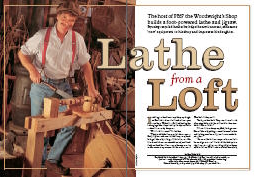
Roy Underhill’s treadle lathe article describes a lathe built from discarded lumber salvaged from the dumpster outside a university dorm. This article comes to us compliments of the Woodworking magazine blog, originally published in the October 2000 issue of Popular Woodworking magazine. Underhill’s usual humor augments the constructon details for a lathe is smaller and lighter than the one Roy often demonstrates on Woodwrights Shop TV program. It fits very well with the idea of using standard size construction lumber and has a number of features that simplify construction, such as connecting the pittman arm directly to the flywheel instead of fabricating a metal crank. While a nice feature, it requires the flywheel be cantilevered, and I wonder about the durability of such an arrangement. An appealing added feature is a lightweight scroll saw attachment. I definitely want to use this idea, but will build one a lot more robust.
All in all, this is a fine article with a very complete cut list, good instructions, and a bit of Roy’s humor. It strikes me as a fine “starter” treadle lathe.
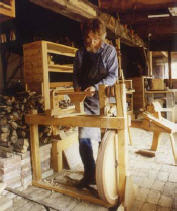
Steve Schmeck keeps a website covering a variety of topics, many of them environmentalist in nature. His lathe plans have been available for several years. Steve’s lathe is quite a bit like the pictures published in the first of these lathe articles, substantial in size, but still manageable for transport in his van. It lacks the diagonal braces shown on some designs. An added feature of Steve’s lathe is an optional tension adjuster that alleviates the chore of resewing a stretched drive belt. Like all of the lathes I considered, construction is from construction grade lumber with hardwood mixed in where you think appropriate.
You bike riders might want to check out Steve’s homebuilt “Woody” recumbent bike. Yep, a wooden bike.
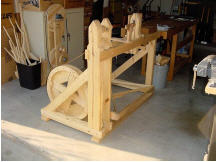
Mike Adam’s lathe is somewhat similar in size and construction to Steve Schmeck’s. He does the various bearings and the crank a bit differently, housing bearings in hardwood inserts. His foot pedal is a full width frame, not just a single board as in the previous designs. Being a bit klutzy, this wider pedal holds appeal for me. Mike’s spoked wheel looks great, but he admits it was too difficult to construct and needed additional balancing once done. That’s why I decide on a solid wheel. While updating this article, I find that Mike’s web presence has sadly disappeared.
Update (Oct, 2022): Stephen Shepherd’s website has disappeared from the interwebs. A couple of years ago, I heard he was having health problems. I certainly wish him well and will leave his link here in case he gets back on the air.

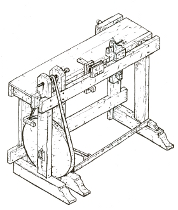
Followers of Stephen Shepard’s Full Chisel blog will recognize Stephen as a restoration specialist and expert artisan for nineteenth century woodworking (from the turn of the century until “the unpleasantness between the states”). Stephen’s plans are available from his own online store. True to form, Stephen’s plans are excellent, drawn from an 1805 exemplar. They are very complete, comprising eight 11″ by 17″ plates and 4 pages of commentary. This lathe is distinctly different from the others, being a combination lathe and workbench. The wheel is more forward, pivoting from within the headstock uprights instead of from diagonal braces further back as in all the other designs. A bench surface extends rearward for 12 inches beyond the spindle centerline and is the full width of the lathe. A small vise attaches to the back edge of the bench. It is a clever design for those pressed for space. Also interesting are the several purpose built, hand wrought, chucks. They appeal, but will require finding a blacksmith.

Lastly, I referred to web material by Howard Ruttan. His is, alas, not a set of plans, but a comprehensive FAQ with yet more links to research.

Lams

Many of the lathe components need to be thicker than typical construction lumber. Thus, we laminate. My nearby home center stocks the usual number 2 lumber that’s useful for framing. Like most of this stuff, the narrower pieces are the worst available, often being milled from trees barely large enough to contain a single 2×4. I buy much wider boards and rip them to the widths I want. One good feature of most of their lumber is that it is reasonably dry and does not need a lot of acclimation.

The lamination process is simple. It consists of these steps:

  • Plane the intended faying surface enough to ensure a good join. This is most useful to remove cupping; planing only the faces that will join each other. The jointer plane is your friend here.
  • Rip.
  • Glue and clamp (currently using yellow carpenters glue). When laminating, ensure stability by having the outer edges of the board, the edges toward the bark, face each other. The end grain should look like this: )))(((
  • Plane off the crowned edges (if any), using first a scrub (#40) and then a jack (#5).
  • Remove most of the surface uglies with a smoother (#4).

Effort and energy cost: about one Snickers bar per 10 foot lamination.

Filed Under: Shopmade, treadle lathe

Treadle Lathe – the Wheel

February 19, 2010 by Bob Easton 4 Comments

The one point of agreement in the many plans I’ve collected is having a flywheel of 24 inch diameter.

Construction varies with the different plans, some with interesting spokes and rims, some solid. I chose solid: easy. I like easy. It wants to be a substantial wheel, the heavier the better. Two layers of 2-by lumber would do it. However, that would leave a seam in the middle of the wheel. What if I decide to drive it with a cord rather than a flat belt. Wouldn’t that seam invite trouble as a gutter is routed for the cord? To avoid that eventuality, I used 2-by material for a middle layer, and then attached 1-by material on either side. Yellow carpenter’s glue and a bunch of countersunk screws bring the layers together, each offset by 60 degrees.

Now, let’s make it round. I really really really like doing as much as possible with hand tools. I have a great turning saw that uses Gramercy blades. However, this wheel presents 3 problems. First, the coarsest Gramercy blade is 10 TPI and 1/8 inch wide. That seems a bit skimpy for this cut. I would prefer 6-8 TPI and 1/4 inch wide, a size not available. Second, a wheel really needs to be round with a nicely perpendicular edge, something I imagined hard to achieve by hand. Third, I don’t have enough Snickers bars on hand to power that much sawing.

So, it’s time to dust off the band saw … and extend its table. It didn’t take much to knock together a one-time use table extension that has a pivot hole 12 inches from the blade. It took longer to find the screws than to make the extension. The table on this Rigid saw has holes tapped for 6mm by 16 screws. How many of you can find 4 of those in your loose parts collection? I did. 🙂

There it is, a simple wheel. It weighs 24 pounds. I don’t know if that is heavy enough.

Oh, before I quit, let me show you one very sweet hand drill bit. I learned from my fellow galoots over at the Saw Mill Creek forums that it might be a Cook (US patent) or Gedge (UK patent) pattern. Most of the hand drill bits we see these days are either Russel Jennings or Irwins, with spurs pointing toward the tip. This bit has the spurs turned back toward the shank. It makes a very easy entry, and better yet makes a very clean exit. There’s no tearout at the exit; no need to stop before exiting and drill back from the other side. It seems that Ransom Cook patented this pattern a few weeks before Jennings, but maybe didn’t have as good a marketing department. The Jennings bits prevailed.

Chasing another of the patent references made by Jeff in the forums, I see a patent by James Swan, some 20 years after Cook’s. Swan’s improvment was to extend the cutting edge from out at the curl all the way into the screw. My bit is indeed a Swan. This one came to me as one of a handful of odd bits that Patrick Leach threw in the box when I bought the Stanley brace. It’s the only one of that pattern I have. After using it, I’m wanting more.

Filed Under: Shopmade, treadle lathe

You’re Gonna Build a What?

February 17, 2010 by Bob Easton 9 Comments

A lathe, my dearest, an ole time treadle lathe.

Preserving history at the Kansas City Renaissance Festival
Re-enacting at Fort Osage Missouri

We looked at some pictures a while. She said “Sure, get to it … but, if you show up in one of those costumes…”

These top two photos are thanks to Jerry who preserves history by working with the Institute for Historic and Educational Arts in Kansas City. THANKS Jerry! (As always, click a small picture to see a larger version.)

Why a human powered lathe?

  1. Because I like human powered things, hand-tool woodworking and paddle powered boats, for example. Treadle powered tools have always caught my attention, and now I have time for them. In short, I see a treadle lathe as a neat machine.
  2. There’s no shortage of turned things I find interesting: mallets, tool handles, more tool handles, lidded boxes, chairs (not Windsors), and exquisite wooden bowls. I’m not interested in pens or bottle stoppers.
  3. The lathe will also be the power base for a scroll saw. I have some very interesting scroll projects in mind.

To which design or plan? Choices, choices, lots of choices on the internet. I collected several comprehensive plans (Roy Underhill’s, Steve Schmeck’s, Mike Adams’ and Howard Ruttan’s), and plenty of pictures. All have great merit, and I will build not to one specific plan, but will take bits from here and there. From Roy’s, I will take the concept of the scroll saw. His lathe has one aspect I didn’t care for, an inboard flywheel. It was also skimpier that the lathe he uses on his TV Programs. Mike’s and Steve’s are more robust and have flywheels held between two uprights, not cantilevered like Roy’s. I like the full width treadle of Mike’s, and actually a sturdier one like in the Ft. Osage picture at the top. Guidance for bearings, various shafts, and centers come in bits and pieces from all of the plans and from an email exchange with Jerry.

The attractive feature (to me) is that any of the above designs can be made from readily available “Nbr 2” construction grade SPF (SprucePineFir) lumber. The big orange store up the road has some fairly good Doug Fir that I’ll use for most of it. Some Ash or Oak will fill certain roles.

Oh, for those who like the idea of a treadle lathe but would rather not build one, Chris Yonker makes beautiful lathes and sells them through his CME Handworks eBay store.

OK. It’s time to get to it.

UPDATE: Mike Adams seems to have disappeared from the Internet.

UPDATE 2: Update (Oct, 2022): Stephen Shepherd’s website has disappeared from the interwebs. A couple of years ago, I heard he was having health problems. I certainly wish him well and will leave his link here in case he gets back on the air.

Stephen Shepard suggested (in the comments) another set of plans that I had overlooked. Stephen’s plans are available from his own online store. Thanks Stephen.

Filed Under: Shopmade, treadle lathe

  • « Go to Previous Page
  • Page 1
  • Interim pages omitted …
  • Page 80
  • Page 81
  • Page 82
  • Page 83
  • Page 84
  • Interim pages omitted …
  • Page 129
  • Go to Next Page »

Primary Sidebar

Footer

Recent Posts

  • Sign Your Work!
  • New Frame Saw / Scroll Saw
  • Lamppost Sign
  • Goodbye PayPal – Goodbye Bob’s eBooks
  • Anarchist’s Workbench is Done

Categories

  • About
  • Artwork
  • Boatbuilding
  • Boating
  • bowl carving
  • Boxmaking
  • Clocks
  • Drawings
  • eBook
  • etude
  • Eva Too
  • Eva Won
  • Fiddlehead
  • Fiddlehead model
  • Flying
  • frame saw
  • gilding
  • green woodworking
  • Grinling Gibbons
  • Guns
  • Hand tools
  • Humor
  • kerfing plane
  • Lettercarving
  • Mill Creek 13
  • Model building
  • Power tools
  • Rant
  • resawing
  • scroll saw
  • Shopmade
  • sign painting
  • Stonework
  • Swimming
  • Technology
  • The Wall
  • treadle lathe
  • Uncategorized
  • VSD
  • Woodcarving
  • Woodturning
  • Woodworking
  • workbench

Other stuff

  • About
  • Contact
  • Privacy Policy

Copyright ©2024 · Bob Easton · All Rights Reserved